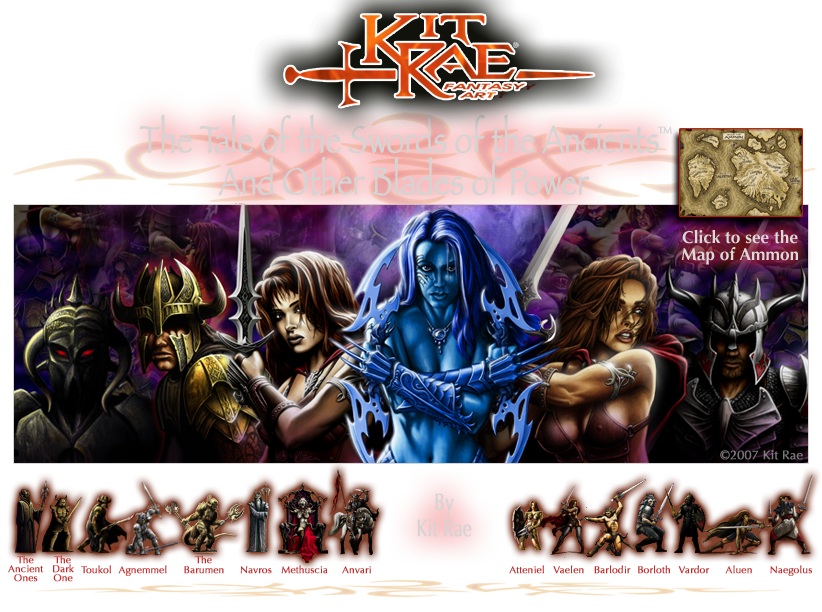
The Tale of the Swords of the Ancients
and Other Blades of Power
A Mythology By Kit Rae
Chapter 1
Of the Ancient Ones Printable page Back to top
In the beginning of things in ages past there were the Anath, masters of flesh, fire, and steel, who forged the elements of which the land of Ammon was made. It became the world in the First Age, the age of creation. The Anath desired to create beings like unto themselves to dwell upon Ammon, thus they created the Ancient Ones, and this was the Second Age of Ammon, the age of the immortals. They were made in likeness to the Anath, and each was granted a special power of creation so that they may rework Ammon in their own fashion. Being immortal the Ancient Ones would not die or age naturally, though they could be harmed or killed by misfortune or misdeed. Thus their number, which was only but fourteen in the beginning, would ever be thus unless fate would diminish them.
The ancient Ones were joyous and learned to harness the elements. They were experts in all crafts and the arts, but soon became saddened because they were alone in the world. The Anath beheld their sadness and thus resolved to give the Ancient Ones the power to create mortal beings and so charged them to rule over and protect those creations. Thereupon the Ancients filled Ammon with many strange creatures of different form, and this was the Third Age of Ammon, the age of mortals. The firstborn to Ammon were the higher beings, the elves, and later there were Uldurin, followed by men, and finally the lower beasts. The Ancient Ones purposed to have dominion over every creature and for many ages they kept order and balance in Ammon. They built the great Temple of the Anath, hidden in the frozen realm of Ulaine, and from its immense halls they watched over their creations.
Mortals multiplied and explored the lands of Ammon, discovering the many great places of beauty the Ancients had created for them. Though mortals were wise and with much strength, they were also unstable through the weakness of the flesh. Through greed, the lust for power, and jealousy, they were tempted to war amongst each other and there was much bloodshed in the beginning. Thus the Ancient Ones created the first enchanted talismans to temper mortals and restore order and balance. They took the form of steel bladed devices, for blades were among the first tools to be used by mortals in Ammon. Each was bestowed with powers of many forms, but the mortals misused them and were corrupted by the new power, and much blood was spilled with them and by reason of them. The Uldurin waged war upon men. The elves moved underground to escape the chaos above, and they became the Dark Elves of the Underworld, Barkonia. In this chaos the first Ancient One came to be slain by a mortal one of the Uldurin race. This was the first slaying of immortal by mortal and Ammon was forever changed. Thus Ammon entered the Fourth Age, the age of chaos. Thenceforward the talismans became known as the Blades of Chaos, for that is what they had created.
Evruc, one of the Ancients now known only as the Dark One, perceived how easily mortals were corrupted, and how vulnerable his own kind were to them. In his mind he had dark thoughts over how best to rule them, and he opposed the other Ancients, causing much turmoil. He forsook them and left to dwell in the Underworld, and there he became dark and twisted. He took many men as his slaves and many women as his concubines. The elves, who also dwelled in the vast Underworld, eschewed Evruc, and named him the Dark One, but some were corrupted by his power and joined him as subjects. They became the Black Elves. In this time the Orwenoch, mysterious dark beasts, appeared out of the depths of the Underworld, and it was said that they were a creation of the Dark One.
The twelve Ancient Ones, seeing the grave mistake they had made, set forth to create the Umethar , a talisman to restore order to the chaos. It was given the shape of many blades within blades, for it held powers within powers. The hilt was carved from bone of the Ancient One who was slain, known as Thorcan, and the pommel was fashioned in the image of the Anath. The blade was quenched with the blood of every immortal Ancient One, save Evruc, and within it was held their greatest power. The Ancients commanded mortals use the blade to heal the hurts they had caused, lest ere long they destroy themselves by their own hand; and they took the Umethar and by its power they brought life back to the dead mortals who had been slain in wrath over the Blades of Chaos. Order and harmony were restored between mortals, for a time.
Chapter 2
Of the Avaquar Dagger Printable page Back to top
The Avaquar Dagger was a blade of power, a precursor to the great Swords of the Ancients, forged late in the Fourth Age of Ammon. Its lore has been kept secret for many ages and few mortals know the full tale of this sacred blade. After the creation by the Ancient Ones of the disastrous Blades of Chaos in the Fourth Age, the Ancients desired to create new and far superior blades of power for the mortals under their charge. These new blades would hold greater powers than the Blades of Chaos. Atnal, a chief among the Ancient Ones who was known to travel amongst his mortal subjects in the guise of an old man or elf, commissioned the famed weapon smith Mahgnim to forge a double bladed knife for him, the Avaquar Dagger.
Atnal gave the design of this unusual weapon to Mahgnim in a dream, and from that image Mahgnim began his work forging the two blades of the Avaquar from his own special steel, created from a blend of ores mined from the caverns of Barkonia and the Tellorien Mountains. The blades he engraved with Annundtal runes, a language of old Annundos, and the words written there came in a vision sent to him by Atnal. The runes told of the Avaquar's will over the waters of the world, with the power to create drought or flood by its command. Water creatures of many types were also held under its influence. Its hilt was fashioned with a clawed metal guard and a grip carved of red thorcan. When Mahgnim completed this knife, he proclaimed it his greatest work, and presented it to Atnal. Atnal and the other Ancient Ones thence embodied the blade with the powers spoken of in its runes, and they created a great blade of power.
As a test of a mortal's wisdom and endurance to use such a blade and not fall into corruption by the influence of its power, Atnal sought to give it to the wisest of the Dark Elves, the warrior Agnemmel. He was an Elf of the Evesfael family, a clan of wise warrior-rulers making their abode in the underground caverns of Barkonia. The elves had fought in many bloody wars against mortal men, but the Evesfael were instrumental in ending the wars and leading the Elves underground to create their own kingdom, away from the world of men. Agnemmel was the grandson of the elven king who led his people into Barkonia, and he was blessed with much of his forefather's wisdom and strength. Atnal presented the Avaquar to this one as a gift and instructed him in its use and of the dangers of its powers if misused.
For many years Agnemmel wielded the blade wisely, using it to make the waters of the underground lakes plentiful with fish for harvest, and emptying the deep flooded caverns of Barkonia of water to allow the elves to expand their kingdom deeper into the earth, but rarely was it used for violence. Then came a day when Evruc, one of the Ancient Ones who had become twisted and dark, snaked into the elven kingdom and spread his evil and malice amongst the Dark Elves. Most of the elves shunned Evruc, for they know him to be the king of lies and one who lusted for power, and they called him the Dark One. Some Dark Elves, however, succumbed to his lies, believing the Ancients had forsaken them to the bowels of the earth for they were not as favored as Men, or those of the Uldurin race that still live upon the surface of Ammon. Those elves that followed Evruc were the Black Elves, and they caused much turmoil in Barkonia, but they were a minority and held no real strength. There came a time when Agnemmel was called to lead a charge of Elves to repel a score of men that had invaded their caverns in the Tellorien Mountains of the West. That battle was a hard one, with many elves having perished including some of Agnemmel's own clan, and worst of all his beloved wife, who was a great warrior in her own right and always fought by his side. His great blade, the Avaquar, could not defeat the mortal men or save her life.
Evruc had heard tale of Agnemmel's enchanted blade and he perceived it was of the Ancient's design, and when he was told of the battle and Agnemmel's loss, he designed to take advantage of the elf's grief. When Agnemmel was at his weakest, Evruc approached him, feigning concern, and he made to sew deep seeds of hate for men in his mind; and Agnemmel did succumb to this willingly, for the Avaquar's enchantments allowed his mind to sway and focus more easily, and therefore he followed Evruc's lead down the dark path. Over time Agnemmel became more and more bitter and desired revenge against men, and he was now the blackest of the Black Elves. He abandoned his clan and left his young son and daughter, who were not yet old enough to fight by his side. He learned to use the Avaquar as a terrible weapon, and with it he would stab men and suck their bodies dry of fluid, leaving only dead husks. With the Avaquar's power he called forth a hoard of dark and vicious water creatures out of the deep underground seas of Barkonia to be his companions and guardians.
Agnemmel led a host of Evruc's Black Elves under his command and waged war upon men for many years. He was known as the Blood Sucker among mortals, and more than two thousand men had been killed by his hand with the Avaquar. Thence came a day when a great legion of mortals, both men and elves, united to destroy his forces and rid them from their lair in the North mines of Barkonia, but Agnemmel's Dark Elves and his sea beasts were of greater strength and turned back the invaders, slaughtering many. In the rage of battle Agnemmel sucked the blood from many men and elves with the Avaquar, and his beasts did feed on their corpses; but in the face of one elf Agnemmel brought down, he recognized someone familiar and once dear to him. As the Avaquar sucked her body dry, Agnemmel saw the face of his beloved wife dying. Now he saw this was not the face of his wife, but the grown face of his daughter who had come to be a warrior over the years since he had left his clan and joined the Black Elves. In seeing her dead body Agnemmel realized what his hatred had brought him; not revenge and justice for his slain wife, but death and misery for all, and he hated himself for what he had become, but most of all he hated the Dark One for leading him to this end. As his dark beasts began to feed on her body he went mad and slaughtered the creatures with the Avaquar.
Thence Agnemmel ran for many long days deep into the caverns and away from other mortals. Eventually he came upon the great underground sea of Tolesthia, a great endless cavern with deep waters and gigantic columns of stone in its midst, seen by precious few in Ammon. There he threw the Avaquar into its waters, and the enchanted blade was lost from the world, though some say it came back to the sword smith Mahgnim in a dream, and when he awoke from that dream the sword was once again in his possession. In that great cavern Agnemmel lived, becoming an insane and dangerous creature, living off blind fish and any elves that happened to stray too deep into the caverns below Barkonia. And there he remained for many years until the Dark One came to call upon him once again...
In the ensuing years came the Fifth Age of Ammon and the Ancient Ones called for the greatest of enchanted weapons to be created, the Ten Swords of the Ancients. The sword smith Mahgnim re-made Avaquar as one of the Ten Swords for Atnal, this time in greater stature as a sword, and blessed with greater powers by the Ancient Ones; and there are those who say the blade of the powerful Avaquar, sword of the deep, was actually forged from the same steel as the original dagger, though none can claim this to be true for the knowledge has since been lost.
Chapter 3
Of the Mithrodin Sword Printable page Back to top
Toukol was a young Elven farrier and blacksmith and who forged farming tools and horse shoes in the late years of the Fourth Age of Ammon, at the time when the Great Realms were still young, long before the time of Vaelen. Toukol lived in the North Kingdom of Deylindor in the city of Ammoria, abode of both Men and Elves. He was an exceptional blacksmith who was also schooled in the art of sword combat, for he had hopes to one day be the weapons master for the King's army like his father. Upon a day Toukol was laboring over his father's ancient anvil, working an iron bar into the shape of a scythe, an old man dressed in gray robes wandered into the shop. The man looked about the place at the various tools Toukol had forged and then smiled. He hobbled over to Toukol, reached into his robe and removed a chunk of molten ore, about the size of a fist, and set it upon Toukol's anvil. Without a word the man turned and walked from the shop. Bewildered, Toukol rushed out into the street after the man, but he was nowhere to be seen.
The ensuing years leading up to the end of the Fourth Age were filled with many wars and bitterness among the three mortal races, Men, Elves, and Uldurin. The Dark One, who stirred much malcontent amongst mortals, had caused great turmoil in these times. Toukol, now an adult Elf, had become one of the greatest of Elven smiths, forging stunning works of swords and amour, and he lived in the underground realm of Barkonia with the Dark Elves, experts in the mining of ores and their crafting. Toukol was also a very capable fighter who had fought and won in many sword tournaments using weapons of his own making. He could have served in the Elven army, but Toukol chose to study with the Dark Elven smiths. He had even adopted the Dark Elves practice of tattooing ones body upon completion of a special work that surpassed anything made before, as a sign of accomplishment. Much had he learned from the Dark Elves in the working of steels, and much in the ways of forging had he invented himself. The Ancient Ones walked freely these days in the caverns of Barkonia, sometimes in the guise of mortal Elves so that they would go unnoticed, and it was their wisdom that had taught the Elves much in the knowledge of steel. In this time the Ancient Ones devised a plan to bring peace and harmony back to the Great Realms and the mortals they had created to populate those lands, and thus they commanded the Dark Elves to forge for them ten great swords; and the Ancients would imbue these with special powers, and through the use of these swords would balance and order be brought to the land once again.
There came a day when the Ancient One known as Atnal walked into Toukol's shop and examined his work. Toukol bowed and a smile strangely familiar to him crossed Atnal's face. Atnal then turned to Toukol and commanded that he forge for the Ancients a great sword, one which would be the grandest and most powerful of the Ten Swords, and it was to be called Anathar. Only the finest blacksmiths in Ammon were asked to forge these ten special swords and Toukol was honored by this request. At once he ran to the back of his shop and brought out the fist of special ore that had been given to him by the strange old man when he was but a boy in Ammoria. He showed the special ore to Atnal, for he had plans to forge Anathar's blade from this steel. He had stored it away since childhood for a special purpose, for he knew in his heart that it was enchanted; but Atnal told him to save the steel and use the Elvish ores of Barkonia to craft Anathar's blade. Atnal then reached into his robe and brought forth a reddish bone-like stone, which he called Thorcan, and he said it must be used in the hilts of the sword. Thus Toukol began his work, forging Anathar for nine moons. When complete it was indeed the finest of the Swords of the Ancients; and when it came into the world it brought with it the dawn of the Fifth Age of Ammon, the Age of Order.
In the one hundred and twenty-eighth year of the Fifth Age, the Battle of the Ancients had been fought against the Dark One. Six of the Ancient Ones had perished in that war, but the Dark One's body had been destroyed and his spirit now stayed imprisoned in the Neverworld. His malicious deeds could no longer be wrought upon the land. The newly forged Swords of the Ancients were in use throughout the Great Realms, and the Ancient Ones gave the most powerful, Anathar, to King Aghelm of Ammoria; but order had yet to come to the land. In this time the Uldurin made frequent attacks upon the Northlands of Deylindor, coming down from the frozen Isle of Ulioc. They were jealous and desired those swords that the Ancients had bestowed with special powers, a desire fueled by the malcontent stirred by the Dark One prior to the war, and it infected their entire race.
Toukol had since returned to Ammoria a master smith and was made the King's armorer, and he forged many great swords for the King, his sons, and the military captains and generals. A day came when word was sent of an Uldurin attack upon the Eastern Kingdom of Volcemis. The Volcemites called for aid from Ammoria, and King Aghelm did respond, sending the better part of his army East; for he feared that if Volcemis fell, his kingdom would be assaulted next. This decision would prove to be a fateful one for Ammoria. On the day the King's army marched East, a familiar old man in gray robes hobbled into Toukol's smithy, admiring the great swords, spears, and armor that lined the walls. He smiled at Toukol, a familiar smile, and spoke that Toukol had grown to be a fine weapon smith, the finest in all of Ammon. Thus he told that now was the time for Toukol to forge his greatest sword, one of perfect design and balance, one to befit each of the numerous styles of sword combat, for the day would soon come when this new sword style would be in need. Toukol was puzzled and asked who would need such a sword, and the old man replied "Mithrodin", which means sword-mother in the Ancient's language of Aerlundtal, or literally, "sword protector". He told that Toukol must forge this sword in twenty-nine days, and that Toukol himself would be the first to spill blood on its blade, but that the weapon was meant for one other than him, this Mithrodin. He asked if Toukol possessed a good ore with which to forge the blade, and smiled again. At this Toukol rushed to the back of his smithy and retrieved the fist of ore from his old storage chest.
When he returned he discovered the old man was again nowhere to be found, but on his anvil lay a new iron hammer of the blackest steel. Toukol hefted it and found it had good weight and balance, but was amazed that it required little effort to wield. Thus he began to think on the shape this sword would take, and that required long thought. Finally Toukol decided on a curved form and thence he heated the fist of steel until it glowed the yellow of a late day sun, and began to hammer and shape it; and he folded it over upon itself for strength many, many times, until after twenty days he had folded it over one hundred and fifty times. On its blade he engraved his maker mark and "Honor ruled by steel" in the Anglecal runes, and "By blood I am the protector of the sacred steel" in Annundtal, the language of old Annundos. He stayed from tempering the blade until he had completed the hilts, which would require much work. He labored over these many long hours, for they were crafted with wood scaled in black whale hide, hardened in resin, and bound in leather, with cast and chiseled metal fittings. Now twenty-eight days had passed, but neither the old man nor the "Mithrodin" had come to check on his progress. Toukol was work worn and questioned to himself why he labored so hard on this sword when he had not settled on a fee, and he did not even know for whom he was working. He decided to rest for one day before tempering the blade and attaching the hilts and fittings, and he hid the unfinished sword in his basement. He thought that since he had neither seen nor heard from the old man that a few extra days to complete the sword would be of little matter.
In the night Toukol dreamed of a warrior fighting in a massive battle with his sword, but when the warrior turned to him he saw the face of a woman. He was stirred from this hard slumber by the sound of bells and when he rose to investigate he found the people were running through the streets in a panic, the call to arms bells were ringing throughout the city, and the glow of fire was in the sky. Ammoria was under attack from the North by the Uldurin, but most of the King's army was far away in the East. The gates had been broken and the enemy now ravaged the city, and some rode in on terrible Snow Drakes from the North. Those white lizards were reaping great destruction and death, for they exhaled a deadly gas that could be ignited. Most of the men captured by the Uldurin had been killed and the women, unless elderly, were taken captive. Toukol knew there was no hope to resist this horde without an army and that by morning the city would be lost. He determined that he must flee Ammoria while he was able, and thus quickly packed his enchanted hammer, forging tongs, and a few other precious tools into a sack, unsheathed a light thrusting sword and ventured into the streets. He made his way toward the South gates, near to the King's palace. After a frightful encounter with a group of Uldurin foot soldiers, whom Toukol slew, he made his way into the courtyard of the King's palace; but the way was crowded with a terrible host of Uldurin massing toward it, and one rode a Snow Drake across the yard, spewing blue flame at the elf guards who protected the palace. There air was filled with smoke and the screams of the unfortunate ones unable to escape the slaughter. Toukol was shaken and retreated back into the narrow city streets in search of a clearer way to the gates, and thence he spied a young girl and two old men with swords, of royalty by their attire, and the girl beckoned him to follow. She led them hastily through narrow, winding passages to the South gate wall, but once there they were surprised by a band of Uldurin blocking the way, corralling prisoners into a cart. The young girl was captured, and when Toukol and the old men tried to intervene they were overwhelmed and Toukol was beaten into unconsciousness...
When Toukol awoke he found himself jailed in a cell with a group of men, mostly young city workers, but the girl and the old men were gone. The Uldurin had discovered that he was the famed blacksmith of Ammoria by the tools in his pack and had let him live, for they would need his services. Thus he was later jailed in his own smithy, always with a guard, and iron doors of his own making were set to bar the exits. Toukol was at his spirits end in seeing what had become of this great city, now overrun, blackened, and crumbling. The glory of Ammoria was now gone and it was home to him no more, only but a prison. Over time he discovered that the King and every one of his guard and family had been slain, and the great sword Anathar had been found and taken by the filthy Uldurin lords.
Toukol was forced to forge weapons for an Uldurin war master, and this he did, but he only forged inferior blades that either bent or chipped and shattered upon hard use. For many months Toukol slaved for the Uldurin, until one day he told his captors he could do no more unless he was brought ore to work with, for his stores were now empty. Now the Uldurin were no masters of steel, and few of their kind were miners, so his master let Toukol leave the city with ten guards and travel to the Ammorian mines in the mountains, where he would fill his cart once a month with the precious ores needed to forge steel. Now four long years had passed with Toukol slaving for his captors in this way. He had hopes that the Elves of the East would one day come to reclaim Ammoria, but that day never came, and Toukol feared that they too had been slain. He often thought of the young girl who had helped him that night and wondered what had become of her, and in his mind he imagined that she had escaped her captors and fled the city, and this helped to pass the days.
Over time Toukol devised a plan of escaping Ammoria by eluding his guards on one of his trips to the ore mines, and thus he prepared his escape for weeks in advance. On the night before the mining trip Toukol was brought his evening meal by an Elven slave girl. The Uldurin had kept many young women alive to work in the kitchens, and he found this night there was a new girl that he had not seen before in all of his time as a captive. To his astonishment he recognized her as the same one who had tried to help him leave the city that fateful night, though she was now no longer a girl but a beautiful young woman, and Toukol was instantly smitten with her. She was joyous to see him again, for she thought he had been slain. Her name was Estea, and Toukol decided that he could not leave the city without her, for he had already fallen in love. Thus he whispered his plan to her, and Estea told thence that she was once a member of the King's royal house, a caretaker of the King's possessions, and doorkeeper of the sword chamber where Anathar was kept. She had tried to protect the sword when the King Aghelm was slain, but she was no fighter and had to flee the palace. The Uldurin lords had captured the sword, and Estea had since learned from palace slaves that it was still kept there in the basement catacombs, though now guarded by many Uldurin. She told Toukol that she would never leave the city without the sword, for she took an oath to the King to protect it, and Toukol revealed to her that he was one who forged Anathar for the Ancients. Astonished at this, Estea thence begged Toukol to help her, and told that before the Uldurin had taken the city King Aghelm had made a secret underground passage which connected the sewer ducts under his palace to a winding cave that lead outside the city walls to the West, where it opened to the mountain side, near to the ore mines. It was to be used as a way of escape in case of attack, but the King fought to the bitter end when the Uldurin attacked, as was the Elven way, and the passage was never used. Toukol knew of many ways into the sewer duct system and he formulated a new plan with Estea. He pledged that he would train her in the ways of sword combat, for he was a very capable swordsman himself, and when she was prepared they would recover Anathar from the Uldurin together.
In the night after his return from the mines, Toukol climbed to the top of his smithy, and using a rope and hook he had forged, made his way by rooftop to the slave quarters where Estea awaited him as planned, and Toukol smuggled her out of an upper window and down into a nearby sewer duct, undetected. They made their way through those dark and dank tunnels by torchlight until they came to a main intersection chamber near the palace where fresh water flowed through, then Estea lead the way to the cave passage. Whence they reached the caves exit in the mountain side Toukol left Estea with his store of food and a sturdy knife. He promised to return, then swiftly made his way back to the smithy before the morning guard changed. For two weeks Toukol worked by night digging a tunnel from his smithy basement into the main sewer duct that ran in the street beside his shop. Twice a week he would travel at night to Estea and bring her provisions, and he trained her with wood swords by firelight, as he had been trained as a young elf. When he was able, Toukol smuggled other female slaves out of the city into the caverns, and he trained and armed those women as well. Over time Estea became very proficient in sword combat and within a year she could best Toukol himself in practice, thus Toukol taught her other forms of combat, and he forged for her a great bladed spear, and it was called Allaxdrow. After mastering each level of combat, Estea would tattoo herself as the smiths of Toukol's trade would, and soon she had many tattoos displaying her great skills.
When two years had passed Toukol's host of warriors living in the caves then numbered twenty-three and Estea was confident they were now ready for real combat, thus she told Toukol of her plan to enter the palace from the sewer tunnels and steal Anathar back from the Uldurin. Though it was difficult to hide it from his captors, Toukol had resumed working on the special sword he had begun to craft so many years before at the urging of the mysterious old man. Now its blade was tempered and quenched and its hilts complete. He greatly desired to wield it against the Uldurin, who so deserved to be slain by its blade, thus Toukol agreed to the plan. One week following he lead his host into the winding tunnels until they came upon four iron gates blocking the passage into the catacombs beneath the palace, and Toukol broke each with his enchanted hammer. Thereupon the women entered the catacombs swiftly and silently killed the host of Uldurin that made their abode in the lower levels of the palace, as Toukol and Estea hunted for the sword chamber wherein the Uldurin masters kept Anathar. After a time they ascended many floors and came to a passage with heavy guard. The door wardens fought fiercely but were no match for Toukol's deadly new sword and Estea's bladed spear; and breaking the iron door they found Anathar on a bloody sacrificial throne. Unspeakable horrors must have occurred at the hands of the Uldurin for there were bones of Elves and rotting bits of flesh littering the chamber, and the place stank of death. The alert bells now rang through the palace and Toukol knew they could not linger. The warrior women had escaped fast to the cave passage upon hearing the alert but as luck would have it, Toukol and Estea were late and found the sewer intersection discovered and blocked by the Uldurin. Thus they were forced to go by another way and return to his smithy with Anathar.
Toukol hid Estea and in his basement tunnel. The Mithrodin sword and Anathar he hid in the box of mining tools stored in the back of his horse cart, for if she were found with either she would surely be slain, and Toukol lover her more than anything and could not have this. When morning came the Uldurin soldiers searched every building in the city, but they discovered neither Estea nor the swords. Toukol knew he must take them from the city soon, thus he told his master that he needed travel to the mines once again for supply, and Toukol was granted permission without question for he was a long trusted servant. That night Toukol secretly packed his forging implements and great anvil into the box of mining tools in the back of his horse cart and Estea hid in the empty ore crates. Her spear Toukol fastened to the cart's underside. In the morning the guards came to escort Toukol, and he was surprised to find their number was not the usual ten, but twenty, but only two were on horseback. Perhaps he was not now as trusted as he thought. Though the guards rarely searched his cart, Toukol made to distract them by offering bread and mead, and to his relief they made no inspection before departing. Once they were far from the city and the guards had eaten all of the bread they began to drink. Soon they became sick, for Toukol had poisoned the mead with metal powder from his forge. With surprise Toukol and Estea leapt from the back of the cart. Toukol challenged the foot soldiers as Estea retrieved Allaxdrow from under the cart. Short work was made of four soldiers by Toukol, but he was hindered when his calf and chest were cut, and the others closed in. The two horsemen rode away fast but Estea made a skillful throw and speared both, for they rode single file. Thence she took up Toukol's Mithrodin sword and with amazing skill and speed that far surpassed his, she cut each Uldurin down to the last, and that one she beheaded with a quick stroke. Estea was amazed at the ease and fluidity with which she could wield this sword and marveled at how it felt in her hands. Thence she retrieved the horses and they rode fast with Anathar to the entrance of the secret cave in the mountain side. Estea's warriors were there in waiting and they tended to Toukol's wounds, but he found two of them missing, for they had been slain in the palace battle, and he mourned for them.
Before the morning light shone an approaching horseman discovered them and entered the cave entrance with such stealth that none heard until he was upon them. Estea prepared to spear the rider and Toukol drew the Mithrodin sword from its scabbard, thence he spied this was no Uldurin scout, but an old man who he recognized. When the man approached his form changed from that of a mortal to an Ancient One, tall and majestic, and Toukol recognized him as Atnal, the Ancient who commanded him to forge Anathar years before, and then later the Mithrodin sword in the guise of the old man. Toukol bowed and presented the sword to him, but Atnal refused. Instead, to Estea he handed the sword, and he spoke it was forged for her and her companions, for they were to be the "sword mothers", the Mithrodin protectors of the Ten Swords of the Ancients. An he also spoke that they were also to be protectors and servants of the remaining of his own kind, the Ancient Ones, for there were now only but three left in Ammon. Atnal told that the time of the Ancient Ones was soon coming to an end and mortals must take charge of the talismans if order was ever to come. They must protect Anathar and each of the other Ten from falling into the hands of the enemy, but they must also learn to harness the swords powers and use them wisely when in need; and that knowledge Atnal promised to teach them. This trust Estea accepted, and she bowed and kissed the hand of Atnal, thus he gave blessings to her and her sword. To Toukol he charged to make like blades to the Mithrodin sword, one for each of Estea's warriors, but Toukol refused, saying he could never make such a sword of its kind again without the special ore Atnal had provided. At this Atnal laughed and said the ore was but common, the same as any Toukol used in forging a blade. It was only special because Toukol had made it such with his great skill and craft. Toukol marveled at this, for he had always thought the steel enchanted, and he thus accepted his charge as sword smith for the Order of the Mithrodin.
Atnal once again took the form of the old man and remounted his horse. He turned to leave, but spoke one last time and told that the Elven host from Volcemis was even now planning an attack on two fronts to reclaim Ammoria from the Uldurin. The foot soldiers would arrive from the South, and the great ships of the Volcemite mariners from the North. He warned that Toukol had but twenty-nine days to prepare, for they would make their assault at first light on that day, and they would need the aid of the Mithrodin. At this he kicked his horse and rode away fast. Thus Toukol set himself to work, for he had many swords to forge with his enchanted hammer and time was passing quickly!
Chapter 4
Of the Swords of the Ancients and the Fifth Age of Ammon Printable page Back to top
The Ancient Ones were born to the world of Ammon with the enchanted powers of creation and destruction bestowed upon them by the Anath. Those powers prevented the world from decaying into desolation and ruin. Knowing that their time would eventually come to an end, the Ancient Ones did not trust their powers to be passed on to those of mortal flesh. Flesh could be tempted and corrupted and the great powers left by the Anath could be twisted and altered for ill use, destroying the delicate balance of the world. The Ancients trusted in steel, steel mined from the very earth forged by the creators, the Anath. The Ancients had instilled within mortals the knowledge to work steel into blades, and mortals learned to use those blades with great care, for havoc could be brought with but a quick stroke, or calm by staying a blade in its scabbard. A balance was learned, and the threat of unsheathing a blade was more often than not what kept the peace; but there were times when steel was drawn by greed or corruption.
The steel of the Ancients was stronger than flesh, stronger than the will, even stronger than time. Only in this steel could the powers of the Ancients be trusted, for steel could not be destroyed, only reshaped. Steel would not betray its power for good or ill. The wielder alone, moral or evil, held that choice; but the Ancient Ones knew that if steel were possessed of the perfect balance of powers, that under wise use, order and harmony would remain in Ammon for eternity. The fashioning of steel into weapons and tools became a high art among mortals, and there were many greatly skilled elven smiths in Ammon. Thus the Ancient Ones directed the creation of the Ten Swords of the Ancients and Ammon entered the Fifth Age, the age of order.
The Dark Elves, dwellers of the underworld, were the mortals so commanded to create those Ten Swords. They were the finest smiths in all of Ammon and were masters in the workings of steel, for they had uncovered its mystery of in their time under the earth. The blades of those great swords were forged of secret alloys mined from the depths of Ammon, and they were tempered in the methods taught by the Ancients. Each of the Ten Swords were bequeathed their own special powers by the Ancient Ones, and they granted those powers to the wielder, but the wielder alone decided if that power was to be used for good or evil. Each blade was given a name for its power, and those names were thus:
Kilgorin, the Sword of Darkness. It gave the wielder power to bring darkness and enchantment over ones enemies. It derived its strength from the Neverworld and was possessed of a great evil by many years of use by the Dark One.
Elexorien, the Sword of War. It gave the wielder strategic power and command to unify great multitudes for a single cause. Forged by Mahgnim, it was used in the Black War by Queen Vaelen.
Morthoseth, the Sword of the Shadows. It influenced mortals by its power over the shadow world of thoughts and dreams. It was wielded by Vardor and Borloth in the War of the Shadows.
Luciendar, the Sword of Light. It revealed to the user that which was hidden and showed the true nature of creatures, both natural and enchanted. It was wielded by Barlodir in the War of the Shadows.
Anathros, the Sword of the Earth. It gave the user power to reshape the earth and its elements and was wielded by the king of the Uldurin and later by Aluen in the Shadow War.
Valermos, the Sword of Fire. It gave the user the ability to command creatures in spirit form and created and controlled the flames of Ammon. It was wielded by Vardor in the Shadow War.
Cinthorc, the Sword of Justice. Cinthorc had the power to deal just punishment to wrongdoers, seen through the eyes of the wielder as being wrongful. It was wielded by the sorceress Morgolien in the extermination of the Mithrodin, and later by Vaelen.
Molotoch, the Slayer Sword. The user received boundless skill and speed from the sacred blade, as well as great focused rage to beat down an enemy. Mere mortals could not even lift this enchanted weapon. It was wielded by Naegolus in the slaying of the Mithrodin.
Avaquar, the Sword of the Deep. Avaquar held power over the waters and seas. It was forged by Mahgnim and was the mate of Anathar. Vaelen wielded it in the Last Battle.
Anathar, the Sword of Power. The last of the Ten Swords to be forged, Anathar held within it a part of each of the powers of the other nine. It was forged by the elf Toukol and wielded by Naegolus in the Last Battle.
Anathar was the strongest of the Ten Swords and held a link to each of the others. When together, the Ten Swords allowed the Ancients to have the power of dominion over the lands and all living things in Ammon, to create harmony and order in the world; and the Ancient Ones taught only the wisest of mortals in their use.
Thence there was a time of peace when mortals founded the Great Realms. Men created the North realm of Deylund, the East realm of Deylindor, and the South realm of Amunach, and the Dark Elves created the realm of Lokonia in the Underworld. The Uldurin, always prone to war, had been defeated by men and were driven across the sea to the Northlands where they founded the kingdom of Ulaine. Men built great sailing ships and explored all of the lands across the seas: Loringel in the South, Dagorlund in the East, and Ulioc of the frozen North. In this time the Blades of Chaos, bane to mortals, were gathered by the Ancient Ones and hidden in the Temple of the Anath to prevent their use; but some of those blades were lost to them and remained hidden until later days of the Fifth Age.
For many years the twelve immortal Ancient Ones reigned until their outcast, the Dark One, arose from the Underworld with the Orwenoch and stole Kilgorin, the sword of darkness, from the Temple of the Anath. With that enchanted sword he attempted to enslave men, but the Ancients intervened and a great conflict ensued, The Battle of the Ancients. Six of the remaining twelve Ancient Ones perished by the hand of Dark One and his Orwenoch beasts. Men and elves rallied to the Ancient's cause and helped to defeat the Orwenoch, but many of those horrid beasts escaped and hid themselves. The Ancients hunted for the Dark One many years thereafter, but he was cunning and eluded their gaze.
In the eighty-second year of the Fifth Age the Ancients came to discover the hiding place of the Dark One in the frozen Northern realm of Ulioc, where he had built a dark kingdom and commanded an army of Uldurin bent to his cause. There he was at last defeated with the sword of power, Anathar, and his army decimated, but his own sword of power, Kilgorin, was not recovered. To save himself, the Dark One betrayed the secret abode of the Orwenoch to the Ancients, but he would not tell of whence they came into the world or who had created them. To protect Ammon lest the Dark One gain influence yet again, the Ancients opened the Neverworld, a place half in and half out of the world, where one can be seen as if in a mist but never to be heard or touched; and there he was imprisoned. The Blade of Chaos, Umethar, was made the key to the door of the Neverworld, and it was hidden away in the frozen lands of the North.
The secret hiding place of the Orwenoch the Dark One had revealed was high in the Tellorien Mountains, East of Deylund, and it was there that the forces of the Ancient Ones, allied with men and elves, assailed them. The numbers of those beasts had increased greatly in the years that they had remained hidden, and they numbered near two thousand. Thus the forces of the Ancient Ones were not prepared for the battle and three of the six remaining Ancients were slain; and thousands of mortal lives were lost. The conflict was long and bloody, but in the end the Ancients were triumphant and succeeded in driving the Orwenoch that survived, but ten score, underground into the caverns of Lokonia.
Fearing for the three remaining Ancient Ones, men and elves, at the urging of the Ancient One Atnal, thence created the order of the Mithrodin in the one hundred and thirty-third year of the Fifth Age. The Mithrodin were charged to watch over the Ancient Ones and care for the Ten Swords whence the time came that the Ancients would perish into the shadows, leaving the mortal world forever. The Mithrodin, or Mith as they were called in later days, were a highly secretive cadre of man and elf warriors, protectors in service to the Great Realms. They were made to guard the sacred swords and were given full knowledge by the Ancients of the swords' lore and how to harness the power with which each blade was bestowed; and thus they were granted complete understanding of the mystery of enchanted steel. It was the duty of the Mithrodin to keep order and balance in Ammon by directing their use. Each sword required counterbalance by it's opposite. When a sword of power was used to shift the balance in Ammon, the Mith, through careful counsel and deliberation, would release the opposing sword into the world to counter it. They alone were responsible for recovering and protecting any sword that would fall into misuse, but Kilgorin, the sword of Evruc the Dark One, they never found. The Mithrodin made their homeland in Deylindor, and it was there the nine known swords were kept, but they later created many other grand temples and halls throughout the Great Realm with which the swords were dispersed.
Over the two hundred years that followed, the Orwenoch beasts once again became a threat to mortals, for their numbers had grown in the Underworld and they had spread to the surface. The Southern ranges of Deylund were assailed by those horrid beasts and they devoured many men and destroyed many towns. Thus the Ancients decreed that the Orwenoch must be utterly destroyed and rid from Ammon completely or there would be no peace. Thence there was another great battle fought by men and elves, and the Mithrodin came wielding the Swords of Power and other sacred blades alongside the Ancient Ones, and they used all of their might to defeat the Orwenoch. As before, many thousands of mortals perished in that battle, and two of the three remaining Ancient Ones did die at the fangs of those dark beasts, but the last surviving Ancient One, Atnal, harnessed the power of Umethar to open the gates of the Neverworld in the depths of Lokonia. When the Orwenoch retreated once again into their deep caverns they unwittingly entered the Neverworld, for Atnal had made its opening at the entrance to those caves, and the bulk of that hoard became entrapped there. The Ancient One sealed the door, and thus those abominations were at last rid from Ammon.
Unbeknownst to the Ancient One, a dark spirit had escaped from the Neverworld when that gate was opened, and it was the diminished form of the Dark One. Soon that evil soul made himself whole again and he recovered his sword, Kilgorin, from its hiding place. Thence he hid himself West, across the sea in the dark lands of Dagorlund, fearing the wrath of the Ancients should he be discovered. There he recruited a new army of evil men to do his bidding.
In the deserts to the East the Dark One came upon the hidden city of Nasnandos, and living there were many immortals possessed of strange powers; and these were the first sorcerers known to Ammon. None knew of whence they came or how they became immortal, but it was rumored that these were the lost daughters and sons of the Dark One when he was known as Evruc, and they were spawned from his union with many mortal women in the early ages of Ammon. One of these sorcerers was Methuscia, once one of the most beautiful and wisest women in all of Ammon; and she was the first to discover she possessed strange oracular sight and powers likened to those of the Ancients. She had been thought to be an abomination by mortal men and was ousted from their lands, as were others of her kind. She appealed to the Ancients for help, but they spat on her and cast her out, for they knew who had spawned her brood. Thus she attempted to change her form to that of an acolyte of the Ancients, to live amongst them, but they soon saw through her guise and a curse was put upon her by the Ancients for using this sorcery and trickery. Thenceforward she was to bear a horrid form that was deathly for men to gaze upon. Over time her wisdom turned bitter and she learned to hate all mortals and Ancient Ones, for she blamed them for her plight. The Dark One befriended this one in later days and he conjured up tales of how the Ancient Ones had abandoned her kind, creating great kingdoms elsewhere in Ammon for the favored mortals. He corrupted the minds of the sorcerers with evil thoughts until all were under his influence; and from that time they harbored a great hatred for those of mortal kind and they worshipped the Dark One, though they never knew that the Dark One was indeed Evruc, their true father and creator.
Thence, in the four hundred and second year of the Fifth Age, the Dark One assailed the Temple of the Anath in Ulaine with the help of these sorcerers, and there he did slay with Kilgorin the last of the Ancient Ones, Atnal; and the Dark One found there were no more of his kind upon Ammon, except he. In the temple he found many sacred blades, including the Nasek and the nameless dagger, later known as the Sorcerer's Dagger. Now the Dark One had great courage and feared nothing, surmising that he had no equal to oppose him in all of Ammon. With a host of men and sorcerers he journeyed West across the sea to the Eastern shores of Deylindor and landed at the Bay of Volcemis. From there his forces made a sneak attack upon the city of Ammoria to the West and it was overtaken. It was in that place that he learned of the Mithrodin and their great temples that housed the Swords of Power, and he purposed to possess them. Thus all of his dark thought was bent to that goal, even to the end of his days.
Chapter 5
Of the Exotath Printable page Back to top
It was now the four hundred and fourth year of the Fifth Age of Ammon and Evruc, the last of the Ancient Ones, now only known to mortals as The Dark One, began to ponder on a plan to wrest control of the Great Kingdoms from those mortals. He designed to rule over them and have them worship him as a god now that he was the last of the Ancient Ones to walk upon Ammon. His warrior sorcerers were but few, and though they had overtaken the capital city of Ammoria easily, they had little hope of expanding that victory to include the remaining lands of the Realm of Deylindor, let alone the Realms of Deylund and Lumenia. The Dark One had hinged his designs on Ammoria as it was known for over one hundred years as a Mithrodin stronghold, but there he had found none of the sacred Swords of the Ancients he sought. His forces had ransacked the Mithrodin temples and searched the entire city, and the Dark One himself had used his own special powers to detect the enchantments imbued in those talisman by his brethren, but to no avail. He thence tortured the Mithrodin warriors and servants he had captured, and his sorcerers searched their minds for a sign. It was discovered that many of the swords had been taken to the Realm of Deylund, for the King of Ammoria had known of the Dark Ones coming in advance and had sent them away from the city.
Soon the armies of the Kingdoms of Deylund and Lumenia would come to the aid of Deylindor and would make an assault on Ammoria to reclaim it from the Dark One. Even now he had report that Eolyth, King of the Realm of Lumenia, was assembling his armies to cross the South Ennol Mountains into Deylindor to aid in the retaking of Ammoria. The Dark One was also certain that the armies of Velethia and Visia to the South would be at his gates before long. This thought caused the Dark One no worry for he had confidence in his sorcerer's hold on the city, and his fleet of ships anchored at the Bay of Volcemis would hold off any attack from the sea. It would be at least three moons before King Eolyth's forces reached Ammoria, but he surmised that he would rapidly need to build a real army of mortal soldiers, that the army would need captains, and that those captains would need enchanted talismans to defeat the mortals who held the Swords of the Ancients in their power.
The Elven weapon smiths of Ammoria were now enslaved under the rule of the Dark One and they were among the best arms and armor makers in the Great Kingdoms. The Dark One treated them well and paid good coin for their services, for they were most prized to him. He commanded them to make special weapons of great craftsmanship and strength - swords, axes, spears, and lances - to which the Dark One attempted to use the powers given to him by the Anath and imbue them with enchantments. To this the Dark One was not the most skilled however, for his powers were more for the creation of living beings of the earth and the sea and not for control of the forces of the earth and nature. Atnal, his brother, had been the one most skilled of all the Ancients at the art of enchanting talismans, but the Dark One had destroyed him in the Battle of the Ancients in Ulaine. Thus the talismans created by the Dark One did not equal those magnificent creations of the other Ancients before him, and in most of his efforts he failed. But in one talisman the Dark One did succeed.
The most skilled weapon smith in Ammoria was the elf Firaneth, and he forged two identical swords for the Dark One, each with a blade considered by Firaneth to be the finest ever crafted in his lifetime. Those blades were of deeply fullered dark Elven iron with leather-wrapped blade grips, each edged to cut plate steel armor. The hilts were made with hook taloned iron side guards, decorated with an expertly wrought iron skull of the Yievelloch, a beast of the underground seas. The grips were hand-and-a-half, leather-skinned, and ended in long, weighted pommels. The swords were lightweight and could be wielded with ease. When these were presented to the Dark One he was very pleased and he contemplated many long days as to the power he would affect upon these weapons until he at last chose one that would suit his needs well.
For fourteen days the Dark One labored with his most powerful sorcerers over the steel of these Elven blades, enchanting each with the power to open a passage a few moments forward in time so as to foresee how events would unfold. With this he would make decisions that would best favor his battle plans, for he would be able to see his enemies' strategies in advance, and by the sword's edge he would also have the power to change them. In hand-to-hand combat an opponent would be at extreme disadvantage to the one who could see his every move beforehand. To give these enchantments the Dark One had to bequeath to the swords a part of his own essence, a part that he could not recover. The sacrifice would allow him to control his own destiny, but the Dark One did not realize how much power he had truly given these swords. When the enchantments were complete he named the swords the Exotath in the ancient language of the Anath, Thant. The word “exo“ translated as oracle and “tath“ as steel, thus the oracle of steel was born. In the runes of Thant he engraved these words: “By the Anath that which is to come is revealed to me. By Evruc, master of the Ancients, I am empowered“. The Dark One envisioned that a fierce soldier would wield the Exotath and lead his army. Thus he called for his sorceress Methuscia to use her oracular sight to divine the one he must find for this task.
The beautiful and immortal Methuscia had been cast out by her own kind as an abomination, and cursed by the Ancient Ones to bear a horrible form, deathly for men to look upon, for the Ancients knew her to be one of the brood spawned by the union of mortal Elves with the Dark One, Evruc. The Dark One had corrupted her and taught her to hate mortals, and she had served him since his escape from the Neverworld over sixty years afore. Methuscia loved and worshipped the Dark One, for he was as a father to all sorcerers, though unknown to her in truth he was indeed her real father. Her oracular sight was gleaned for him and she saw the ruthless soldier who would wield the Exotath, one who had served the Dark One in the past - Agnemmel, the black Elf.
Agnemmel, once a great Elven warrior of the Third Age, had been corrupted by the Dark One and had fought numerous wars in his service using the enchanted Avaquar to slay thousands of mortals, including his own daughter. On the day he slew that one Agnemmel became mad, abandoning his service to the Dark One and shunning all other mortals. He retreated deep into the caverns of Barkonia where his sanity left him, and though he was but a mortal, he had lived on for almost nine hundred years. His ancestry was from the ancient Elven lines, and some of those lived to be near five hundred years old, though they retained their youthful health until very late in life, however Agnemmel gained his abnormally long life from a different source. For many years he wielded the Avaquar, an enchanted blade that allowed him to drain the life from mortals, thus infusing his own body with that essence he took.
The Dark One reached out with his mind and could sense Agnemmel's powerful essence and knew he still lived, but could not sense where he made his abode. Methuscia could see in her mind where he kept himself hidden, in his dark caverns among the Yievelloch monsters of the deep, and she felt pity for his tortured soul. Even though Methuscia held distain for most mortals, there was also a kindness and beauty in her heart that did not come from her father. She offered to find Agnemmel for the Dark One, but begged him for one favor in return. Her hideous form would be deathly for Agnemmel to look upon so she asked for the curse to be lifted. This the Dark One could not do, for the combined power of the Ancients had created that curse and it was too strong an enchantment for him alone to break. Instead he had a mask crafted for her of gold that was formed to the shape of her original face, one of the most beautiful faces in all of Ammon. Only her eyes of shimmering pearl light could be seen through its glimmer. To this mask the Dark One bequeathed a charm that would hide her horrid form completely as long as she wore it, but he warned that the moment she removed it the charm would end. He commanded Methuscia to use her allure to seduce Agnemmel and make him fall in love with her so that he might be persuaded to come back into the Dark One's service. She was given two gifts to deliver to him, the Exotath broadswords. Out of her love and obedience to the Dark One she did as he beckoned and thus Methuscia made her way East to the caves of Barkonia to seek him.
Methuscia, in her mask of gold, took her personal guard of six sorcerers and two mortal rangers, who were expert guides and knew the mountains between Deylund and Lumenia well, into the Ennol Mountains of the West. The Dark One had many such mortals as these rangers in his service, for mortals were easily corrupted with coin to go against their own kind and the Dark One was rich with the treasures to pay them, reaped from his many conquests. The rangers led Methuscia swiftly through little known paths of the Ennol on horseback until they reached the foot of the mountains bordering Lumenia where the Abalard river sprung. From there they traveled by night, keeping well clear of King Eolyth's ranger companies who patrolled these borders. Once they had passed into the Tellorien Mountains her guides led her into one of the lesser-used gates that opened into the underground caverns of Barkonia, kingdom of the Dark Elves. They bypassed the great underground Elven city of Lokos and made their way deep under the mountains. From there Methuscia used her oracular sight to lead them through the winding caverns for many days, through a maze of stalactites and stalagmites until her party finally reached the entrance to the heated caverns that held the great underground sea of Tolesthia.
Tolesthia was alight with glowing moss thus no torchlight was needed, and the many hot springs warmed from the depths of Ammon made fire unnecessary. With her sight she knew Agnemmel lived on one of the many small islands that lay just off the shore, but she could not see how or when she would meet him, thus she sent two of her sorcerers across the water to spy him and tell of his state. When those two did not return she sent two more, but those also never returned. Methuscia vowed to go with her other two remaining sorcerers to meet the mad Elf herself but when she was harshly awakened from her party's rest that night to the sounds of battle she found her sorcerers had been brutally slain, their throats ripped open and bodies cast upon the points of stalagmites. Seeing this, her ranger guides fled into the caverns from whence they came, saying this was the work of the Yievelloch, horrid sea beasts of the deep. Indeed, the legends of the great warrior Agnemmel told that his guardians had been those horrid beasts from the deep. Perhaps the tales were true and those creatures still served him. Now Methuscia feared for her life, for if a mortal Elf had servants that could do this to her finest sorcerers, how could she survive to enchant him?
Her sight told her to seek him however, thus she left her gear and clothes and with only the Exotath strapped across her back she swam across the hot waters to Agnemmel's small island. Midway she felt the waters ripple as if some great being were swimming nearby. In the glow of the cavern on the water she could spy at least three of the Yievelloch nearby, but they kept well away from her as if in fear for she clouded their minds with her sorcery and thus made her way to the island unharmed. The place was a maze of rocky spires reaching high to join the towering roof of the cave, and on its sandy shore she saw rotted cloth, rusty armor, and the bones of many men and Elves - those the mad Elf had slain and eaten. With great fear she left the water and stood on the shore. There she called Agnemmel's name using an enchantment to her voice to soothe him and make him at ease.
Agnemmel was indeed mad, for his sanity had left him long ago when he had come to realize he had killed all that he once loved, thus he shunned others, for he knew he could not love or care for his own kind again. His Yievelloch servants would not leave him however, and they followed him into the depths those long years ago, though he hated and rejected them. Though old age did not seen to affect them, many had perished over the years, some by his own hand, some by disease or other more terrible predators of the depths, until but some thirty remained. Other than those serpent-like followers Agnemmel had lived these many long years in isolation brooding over his deeds, both good and evil, until his mind had once again confused the dark with the light and he lost all sense of morality. Feeding on other mortal Elves of his own kind was now no different to Agnemmel than eating a fish was to another fish, and he had honed his skills in hunting them to a fine art. Woe it was the lost explorer who happened to venture into his cavern unawares, for the report of him was now legendary among the Elven dwellers and few risked venturing into the depths past the underground Elven city of Barkonia.
Agnemmel expected the last of the company camped on the sea shore to flee after he had killed half their number, but he was mesmerized by the one whom had swam to his shore, and his cursed beasts were strangely repelled by her. He would have his way with her, feed on her flesh, and then hunt the rangers who had fled and have their blood as well. But this woman moved in such a way that distracted him from his instinctual thoughts, and she seemed to look right at him, though he was well hidden. Thence she spoke his name. Hearing her voice soothed him and brought back long dead feelings remembered from his past. He tried to resist those thoughts but they cut into him, wrenching something to the surface that he had buried deeply. When he saw the woman's naked body walk out of the water and her gold masked face he was entranced, and looking upon that fair face into her pearl eyes his long lost sense returned to him. He came out from his hiding place wielding a curved Elven blade and his muscular instinct told him to slay the woman, but he could not.
Methuscia beckoned him to come before her, which he did as if in a trance, and she told that she was his oracle, come to bring him out of the depths to the light of Ammon once again, for his life had purpose to those that remembered him and his great deeds of the Third Age. Agnemmel dropped his sword and fell down at her knees, for he could not look away from her eyes, nor could he bring himself to harm her. Methuscia took his head into her hands and wove her will into his mind, saying only those words that would go deep to his soul and unlock his conscience again, and with her charms she calmed his rage and seduced him. She made love to him on that shore, amongst the bones of his victims, and Agnemmel, great warrior Elf of Barkonia returned to the world of the sane.
Methuscia told Agnemmel that she was a great sorceress, the Oracle of Ammon, and that he was needed to lead a great army against mortal men, for they were corrupted by the Ancients and were not meant to rule or be masters of the lands, which Agnemmel well thought, for he hated mortals and had killed many thousands in his time, and he despised the Ancients for creating them. She spoke to him of the Ancient's treatment of her sorcerer brethren and how mortals also shunned them as witches and evildoers. In the midst of these talks she made love to Agnemmel over and over, in hopes to numb his will and sexually bind him to her as sorcerers were wont to do with mortals, but to an Elf of the old lines like Agnemmel this only sharpened the senses and made him more alive and aware than he had been for near five hundred years. He wanted more and more, and he took Methuscia at his will rather than hers, though she was resistant to becoming sexually bonded to him she found she wanted him more than her duty to the Dark One called her to. She could see the old soul within him, the one that had loved his long lost wife, the one that had fought for his Kingdom, the one that now felt great guilt welling up inside for the horrible deeds done in his lifetime; and Agnemmel cried in her arms, for the guilt was almost too much for him to suffer. And Methuscia suffered through it with him.
After many days with Agnemmel, Methuscia decided the time was right to pass the Exotath to him. After a long bout of lovemaking she went to the shore and retrieved the two swords in their shoulder scabbards. Telling Agnemmel that his destiny was to be intertwined with forged steel brought back dark memories to him of the evil blades of the Avaquar, his old weapon, but when Methuscia unsheathed the twin swords of the Exotath Agnemmel saw that these were blades of a different kind. He grasped the hilts of each sword, feeling the enchantments they held, and something was familiar about their essence as if they spoke to his soul within for they held a power. Power imbued by one of the Ancients, as the Avaquar had been. He hefted the swords and wielded them through long forgotten moves of his old sword fighting ways, and purpose returned to him. The feel of a strong sword in his hand was the final key to unlock the old Agnemmel. Methuscia knew that he was ready to leave Tolesthia and return with her to his new providence, thus she told they must go to the Great Realm of Deylindor, to the city of Ammoria, and there he would meet her master.
Agnemmel led Methuscia out of Barkonia to the surface of Ammon, East through the Ennol Mountains and into Deylindor. He practiced his old sword fighting ways on their journey, and with the aid of Methuscia's powers and enchantments over mortals he skillfully eliminated several ranger patrols encountered in Lumenia. During this time he began to swordfight with his left hand as well as his right and found he could wield both Exotath at once. Methuscia told him of the swords' great power over the temporal world but cautioned that Agnemmel would have to wait to master it. Though he tried many times to use the swords' enchantments, the most he could conjure was to see his opponent's moves a mere moment before they occurred.
As the journey progressed Methuscia became very close to Agnemmel and he became bound to her, hunting for their food and protecting her when danger approached. Though he often questioned her about the golden mask, Methuscia would say no more other than she had been unjustly cursed by the Ancients long ago with a malicious spell and that if the mask were ever to be removed she would be the bane of the ones she loved and cared for. She told that her master had saved her by crafting the mask to stay that evil spell. When questioned about her master, Methuscia would only say he was a foe to men, but advocate of the Elves and was once friend to Agnemmel, and needed his friendship and loyalty again.
One day out from Ammoria Agnemmel and Methuscia came upon a four-man scout party of King Eolyth's spies returning from a reconnaissance, a prelude to the King's attack. Agnemmel swiftly spilled the blood of the four men, but Methuscia, using her sight, knew there had been a fifth man nearby who had escaped. Rather than blindly search for the man, Agnemmel tried to harness the swords' powers yet again. Holding one sword in each hand he crossed the blades, letting them touch, spoke the runes and concentrated on the movements of time the talismans allowed to flow before him in his mind. He sensed the man but could not see far enough to know which way the man was fleeing. Beckoning Methuscia he made her to touch both blades in the middle and requested she look ahead with her oracular sight. Methuscia saw which path the man would take, and where he would stop to rest in the forest valley, but she also had a strange sensation that she was not only seeing this moment but that she was on the edge of touching it by the power within the Exotath. She pushed the blades apart, uncrossing the swords and found both her and Agnemmel were there, in the forest just steps away from the man. Startled, the ranger reached for his blade in its scabbard, but not before Agnemmel swung both blades of the Exotath wide and nearly beheaded the man when they came together at his neck.
Methuscia was befuddled by what had just transpired. She reasoned that the Dark One had imbued the Exotath with more power than he had known, or had not expected that her own powers could affect the swords' enchantments in such a way. Agnemmel immediately saw how powerful a weapon he had been given by Methuscia's master and he looked upon the swords with awe, asking Methuscia how far into the future she could divine. But Methuscia could not see the future, though she could prophesy paths that several futures may take to the same outcome, which is the gift of an oracle. She told Agnemmel she could foresee that he would win many battles, but she did not always see the exact paths to those battles, as they would change, but certain moments she could divine. She could see that the Dark One would have a son, but she had never told of this, and she saw the Dark One would one day have a massive army of man-like beasts, the Barumen, and he would breed the dreaded Baelin, his great war dogs. These were just moments in the winding threads of time to her, and she rarely gave up these secrets, as revealing too many oracles could change them and at times could cloud her sight.
When they reached the Firaneth River, Southwest of Ammoria, they spied an army encamped along its banks bearing the banners of the Kingdom's of Velethia and Visia. That host waited for King Eolyth's armies to arrive for a joint attack on the Dark One, and they also guarded the only way South in case the Dark One decided to move on their kingdoms. Upon reaching the city Methuscia took Agnemmel through the gates of its massive walls and into the upper levels to the palace, where the Dark One had his throne, and she reported what they had witnessed at the river. Though the Dark One's appearance had changed since the Third Age, when Agnemmel laid eyes upon Methuscia's master he recognized him at once. The face of the Dark One had become younger and more handsome in appearance, but the glow of the Ancients still radiated from him. Agnemmel became enraged, drawing his swords and saying he would never obey the commands of one as vile and soulless as the Dark One again, for the Dark One had driven him into his madness. Methuscia used her charms to calm him and the Dark One pleaded for him to listen, saying that he too, like Agnemmel, had become changed over the long years and had abandoned his quest for power and the bloodlust to kill all mortal life. He now only sought to prevent mortal Men from claiming the world of Ammon as their own, for they were stained by the Ancients to be arrogant and selfish creatures, too proud of their own kind with no respect for the other races. He feigned sympathy for Agnemmel, comparing the Elf's rebirth to his own, and the Dark One told that to prove the truth in this he had only but to feel his spirit in the swords he held in his own hands, for part of the Dark One's own essence was in them and he had been weakened in giving this gift to Agnemmel. In this way Agnemmel was made to see the Dark One's honesty, though in fact all of the Dark One's words and deeds were only made to serve himself. Though there was some doubt in Agnemmel's mind he saw that Methuscia loved this one and obeyed him, and he trusted her for he now loved her. In this way Agnemmel was drawn into the Dark One's service once again, and he accepted his post as general of the Dark One's army, a position he once held over nine hundred years afore.
The best armorers in Ammoria slaved to make Agnemmel's personal armor, forged of polished bright Elven iron plate and gold, and the lightest Elven mail hood, shirt, and leggings were fit to him. The Dark One held an enchantment over his forces so that they would hear and obey his commands by thought rather than by messenger, and he gave this power to Agnemmel as well so that he would have full authority. The Dark One's spies had reported that King Eolyth's army, near twelve thousand strong, was now traversing the Ennol Mountains, only three weeks away, and that King Elliasthol of Deylund had a fleet of thirty ships sailing the Tollard river out to sea and they would strike the Bay of Volcemis to the East of Ammoria only a week after King Eolyth's forces would strike. The war was fast approaching and Agnemmel felt his bloodlust for battle returning. He was given a hoard of gold and coin to buy men for war, but he needed skilled soldiers and there was little time to train. The Dark One had over two hundred sorcerers and over six thousand Elves in his battalions, as well as five hundred men under his command, soldiers of the former army of Ammoria. Agnemmel sent soldiers with coin to the south forests of Ammunach to buy as many able bodied men and boys as could be found to fight for him, and then he hand picked his own captains from best of the Dark Ones forces at Ammoria and began to train them in his own combat strategies, and they were made to pass these skills on to their own men. He knew the best way to win a battle when outnumbered was to outmaneuver the opponent and to have the stronger front line, and he had always led a fierce front line that decimated and broke the opposing armies rapidly.
Agnemmel learned of the many skills the Dark One's Sorcerers possessed; some that simply influenced and swayed the weak minded to do their bidding, some that could harness the elements and make the winds blow or the skies to rain, and some more powerful that could create great heat to roast a man alive or that could move objects by thought and send killing blows to a man from great distance. He assigned one sorcerer to each unit of thirty men, but the strongest fifty of the witches he put within his front line battalions to work in combination on a special enchantment. King Eolyth's army was now out of the mountains and crossing the Torkol Plains of Deylindor, only eight days away. Agnemmel had surmised his chances of defending the city were good, but King Eolyth would be able to cut off supply lines into the city, and they would send fire over Ammoria's walls if they could not be breached. The Dark One would command his imperial battalion of four companies behind its walls, but Agnemmel would take the bulk of his forces, ten battalions of near six thousand Elves, men, and sorcerers, and attack King Eolyth before he reached the city. He sent two battalions South along the Viranef River to distract the armies of Velethia and Visia encamped there, and the bulk of his forces he led West to meet the Army of Deylund two days later in the dark of night on the Torkol Plains.
King Eolyth's army was encamped across many miles of the plains in a long line when a thick fog rolled in from the East at dusk, obscuring the moonlight. The King's advance scouts reported nothing into the night, for nothing could be seen for many miles, but Eolyth's intuition told him that this was the work of the Dark One and attack was imminent. He placed his plate mail armored heavy infantry on alert and formed a line in front of the fog to the East. In the midst of instructing his other battalions of archers and cavalry to form up behind the front line, two scouts arrived and reported companies of enemy infantry were charging from the South into the middle of his encampment, and they carried the banner of the Dark One. At once he sent command for his front lines to move South and ordered his archers to release fire tipped arrows into the approaching host of men. The battle had at last begun and King Eolyth thought this a fine trick by the Dark One, but he wielded Luciendar, the Sword of Light which reveals that which is hidden, one of the Ten Swords of the Ancients. He held it aloft and by its power and light his soldiers were made to see the enemy in the dense fog. These enemy soldiers were not skilled and were easily cut down and his reports told that none of the dreaded sorcerers were among them. The King concluded that these were men of the South, bought easily with coin by the Dark One, and that the real army would come at him from another direction. Even as this thought came to him he had report that both his Eastern and Northern flanks had come under attack.
Enemy archers and stone launchers had loosed their ammunitions from the North and a rain of thousands upon thousands of darts and stones struck the King's men in the dark before they knew to raise shields, and thus many of his own archers and infantry who were facing the other direction were gravely injured or killed. Heavy infantry, at least five battalions, came through the fog suddenly from the East while his army was regrouping, and reports of more battalions were attacking from the North. He ordered his cavalry to the East lines, for the cavalry were the strongest and fastest of his forces, but the horses had become angst-ridden and would not obey their masters. Many threw their riders and trampled them in frenzy, as if some madness had overtaken them. Even the king's own horses that drew his chariots became mad and had to be cut loose. The King's entire cavalry was lost for the Dark One's forces were fierce, spilling the blood of his infantry as they pressed their way into the plains from two fronts, crushing the army of Lumenia. Thence a great and unnatural torrent of rain stormed down on the Torkol Plains, and King Eolyth presumed this new misfortune also to be the work of sorcery.
The King knew the battle was lost, for his men could no longer see because the Dark One's sorcerers had somehow extinguished the power of Luciendar's light. The enemy knew where to move and where to strike in the dense fog and rain, but his own host was lost and blind. He sent word to all his captains calling for his army to retreat, though all that remained were three light battalions, the battalion guard that surrounded him, and fragments of the others. Even as he shouted orders he could see a forest of long spears, several companies wide, appearing out of the fog, many tipped with the heads of his own men. Behind these spearmen were a horde of bronze armored soldiers charging into his ranks, swords swinging madly, and they cut his infantry down. One Elf in silver armor seemed to lead these barbarians, cutting and hacking his way through the King's personal guard, wielding two swords, expertly placing each cut and thrust for precise kills as if he sensed his opponents exact moves before they did. Fast approaching, this mad Elf was heading straight toward King Eolyth and so the King prepared for combat with Luciendar. He could hear the enemy horde chanting ?Agnemmel, Agnemmel?, over and over as the Elf came upon his chariot, cut down his guards, and lunged at him. Though the King was an expert swordsman, this one easily dodged his blows and hewed his left leg off at the knee with one sword while punching through his chest mail with the other, and thus King Eolyth ended, for his heart had been pierced.
Agnemmel thence disemboweled and beheaded the King and he mounted his opponent's head on a pike and held it high as a trophy for his Elves to see. Blood and rain washed down all across the plains as the Elves chanted his name in victory. When the battle was over he called for his sorcerers to end the torrent and cause the fog to clear. Only some two thousand of King Eolyth's men had survived to escape in retreat, but Agnemmel had only lost close to eight hundred of his own soldiers. He sent two battalions after the retreating army. There was more than enough time to move his primary battalions back East to the Bay of Volcemis to aid the Dark One's fleet of mariners anchored there against King Elliasthol's oncoming navy. The enemy would arrive in a week's time with their thirty ships, each sure to be holding a full company of men. His two battalions sent to attack the forces of Velethia and Visia had taken heavy losses but they had driven those armies back South some way, far enough to allow Agnemmel's forces to return to Ammoria without encounter.
With the Exotath Agnemmel endeavored to see his enemies' plans in advance, once he reached Ammoria. But too late he found that King Elliasthol's mariners were not striking by sea in the Bay of Volcemis, but had taken their host from the sea into the North end of the Ammant River which flowed against the ships partway, but then branched and flowed with them South into the Volcemis. It was there they had anchored, only a few miles North of Ammoria and were now marching to the walled city for a surprise attack. The small army from the Kingdom of Nokomis, Northwest of Ammoria, had joined them. Agnemmel had planned to send the Dark One's ships far out to sea before the enemy ships arrived at Volcemis, thence command his sorcerers to combine forces and create a fierce storm on the water, thus spilling King Elliasthol's landing vessels as they brought infantry to the shore while the Dark One's ships attacked from the rear. With the new position of the enemy, these plans were now foiled and Agnemmel had to devise an alternative action immediately.
Agnemmel thus drove his forces North and rammed the Dark One's battalions at his enemy hard, but that host was well rested on their sea journey, whereas his Elves were weary and drained from battle and travel. His sorcerers created a bank of fog from the sea, but fierce winds and the light of day allowed the King's host to see their enemy clearly. The battle lasted but a day, and Agnemmel's battalions did utterly destroy the army from Nokomis and spilled the blood of over half of the King Elliasthol's infantry and cavalry, but the King fared better and he took down three of the Dark One's battalions before he removed his host back to the river for rest and reinforcement from his ships. Agnemmel thence retreated his battered battalions back behind the high walls of Ammoria.
Methuscia was there to greet him, relieved that he had returned safely, and she took him to make his report to the Dark One. The army of Deylund would return at dawn with siege engines to breach the wall, and the Dark One was not pleased, but he did not offer abandoning the city as an option. Agnemmel needed a plan quickly to destroy King Elliasthol's forces in the night, but he could find no charm in the Sorcerer's vast arsenal strong enough to aid him. At his wits end he called for Methuscia to tell him and oracle of the future of this battle, so he may get a glimpse of how to proceed if he were to be victorious. This Methuscia did, but the oracle was not a good one. She told that Ammoria would fall and the King's host would capture the Dark One, and she also told that Agnemmel would live to escape. This angered Agnemmel, for he would never retreat from defending the city or his army, even though the cause may be futile, he would fight to the death with them. He could not surmise any circumstance under which he would flee the city - other than if Methuscia had asked this of him. He begged Methuscia for another path, and there was indeed one other she had glimpsed in her mind, but it was too costly and would result in her losing Agnemmel. She would not tell this to him and would only say there were no other paths for victory, but Agnemmel did not believe this. Thence he told of his love for her and concern for her safety if the city was invaded. Agnemmel begged that she lay her hands on the Exotath and use its power to predict the strategy he needed. This she did, for she also loved him, though the path she told him of would result in doom for them both.
Methuscia gripped the crossed blades Agnemmel held before her tightly until they drew her blood. Speaking the blades runes, she used all of her power to cause time's many flows to appear before her. One of these paths she recognized and followed forward many years in the future. Farther and farther it flowed, near ten thousand years, until she at last spied the Dark One commanding an army of beasts, the Barumen she had envisioned in oracle before, and there were great beasts called Baelin there as well. All of these were stationed in Barkonia, where she had found Agnemmel, though in this future time it was now called Lokonia. The Dark One was their creator and commander, and he was very great and powerful in this time with many legions of these beasts. This was the height of his power, the absolute greatest he would ever become. Overwhelmed, Methuscia thence broke the flow of this vision and collapsed into unconsciousness.
Whence she was awakened she found Agnemmel, the fierce warrior, in tears at her side, and he asked forgiveness for demanding that she seek such a powerful oracle for him. He could not bear to see Methuscia harmed and felt guilt, but Methuscia soothed him. She told of her vision, saying that she had only to open the door to this future time and Agnemmel could command these beasts to follow and fight for him. He was a general of the Dark One and had been enchanted by him in such a way that all mortals and beasts under the Dark One's command would obey him by instinct, even ten thousand years henceforward. All Methuscia had to do was but uncross the blades of the Exotath after opening the door, and by leaving one blade in that future time and one in this, the door would remain open, thus allowing several legions of Barumen to pass through and hearken under Agnemmel's command. If they did this, she warned, it could never be revealed to the Dark One, for this action done now may spell his doom in ten thousand years time. Her oracle did not show this to be fact, but it was one of the many possible consequences she foresaw resulting from this act. She told that this must be done on this night for tomorrow there would be no time to bring the Barumen through the door before the army of Deylund would attack. Though time was short, she made love to Agnemmel, for tonight he would go into battle again, and her oracle told that their time together would be short.
Thence Agnemmel and Methuscia cloaked themselves as commoners and left Ammoria through one of its smaller gates, and they made their way to the hills North of the Bay of Volcemis where they would be hidden from view of the King's ships. Though two scouts spotted them as they crossed the lowland before the hills, Agnemmel had seen them in advance by the Exotath's foresight, and he dispatched them before they could flee to sound the alarm. Once in the hills Agnemmel again summoned the Exotath's power and Methuscia envisioned the oracle and parting the blades the doorway was opened for Agnemmel. He saw the future through this portal, it's edges shimmering in the moonlight, and glimpsed the familiar caverns of Barkonia. He kissed Methuscia, took one of the Exotath, and stepped through into his ancient home, though it was very different now. He passed numerous guard posts into vast caverns that held many thousands of these beasts, bred of men, wolf, and ape by the Dark One. They were fierce creatures, larger and stronger than men, and they could see in the dark. He also saw the great corrals of the Baelin, great dragon-like beasts unlike any animal he had seen in Ammon, even greater than his own Yievelloch. These were fanged creatures with black fur, bony armor and spines like a reptile. Some of these were being fixed with plate mail armor to protect their front sections and some were being mounted with saddle and harness for riding, apparently in preparation for war.
Agnemmel sought out the captains of these legions and told them he was general to the Dark One, commanded to lead the attack, and what passage they would take to meet him. He asked that the strongest from the front lines go first into battle, and was told that his Legion of Barumen axe men would be at the ready by the Dark Elven captains. Thus Agnemmel took an entire Legion of these armored Barumen axe men and four more legions of four companies each of Barumen heavy infantry, with each company having a horrid Baelin to escort them into battle. He led them through the temporal doorway into his own time, where his golden masked oracle waited holding the second Exotath to keep the doorway open. This task took many hours, for only one unit at a time could pass through the opening. By the time his entire army of three thousand Barumen and twenty Baelin had passed through and were regrouped by the Elven captains, the enemy on the beach had already been alerted and were preparing for war.
King Elliasthol's troops were camped on the beaches of the Ammant River, stretching for over a mile. His great fleet was anchored well off shore, but likely within distance of Agnemmel's Barumen archers who carried much larger bows than man or Elf could wield. Agnemmel summoned a vision from the Exotath to observed the opening moments of the coming battle and thus ordered his Barumen captains into prime positions, sending his front line axe men and Baelin head-on into the middle of the camp while the bulk of his infantry would surround the beach on either side. His troops had the advantage of sight in the dark, though they did not have the advantage of surprise. Whence the King sent his cavalry charging up the beachhead, Agnemmel's front line was already well in position. The Baelin struck first, crashing into the King's cavalry and tearing his horses asunder. The Barumen axe men followed, hacking the riders down with their great strength. These beasts were such brutal warriors that scores of the enemy were disemboweled by but single blows from their great battle and war axes and many men had throats torn open by their fanged jaws. The sight of the Barumen caused numerous soldiers to flee in fear, abandoning their charge and hastily boarding landing vessels for escape to their ships. Before long the beach force was crushed and Agnemmel's Barumen archers moved in to launch a flight of flaming bolts at the sea vessels, as most were within range. King Elliasthol's mariners hastily retreated his burning ships upriver, his army utterly destroyed and beaten. Agnemmel looked over this victory with great satisfaction and glee at watching his enemy flee while the Baelin feasted on the beach strewn with their torn corpses.
Whence the ships were gone Agnemmel remained on the beach in thought while the Barumen stripped the dead of weapons and possessions. Their Elven captains came to him requesting orders. Thence he sought out Methuscia, saying that if they returned this army of beasts back to their own time they may not ever be able to call on their aid again if the Dark One from the future forbade it, but an army this fierce if kept here would guarantee victory for them over the Realms of Deylund and Lumenia, for the Barumen were the most effective and ferocious fighting force he had ever seen. Methuscia disagreed and begged him to return them, for she saw this path in her oracle and it would lead to Agnemmel's doom. Though he loved Methuscia, Agnemmel was a warrior at heart and he would not concede to this, even though it brought him scorn. The need for victory was too great in him and thus he marched his new army to the gates of Ammoria.
The Dark One was perplexed at this strange army of beasts stationed at his gates, but when Agnemmel had explained how they had come to be he was intrigued that his own creation, the Exotath, had been so powerful. Agnemmel lied and told that he could open doors in time with the Exotath but could not control them or whence they would open, thus he could not return the Barumen and Baelin to the time whence they came, and when he explained the manner in which he opened the door he left out Methuscia's part in it. Bemused at this, the Dark One did not entirely believe Agnemmel, but a prize such as this army he would not return. The opportunity to crush his enemies was before him and he would now take it. He thus commanded Agnemmel to prepare the Barumen for war upon Deylund. He proposed to lead his fleet of twenty-six ships carrying six battalions North through the Frozen Seas and down the Bellard River to lay siege upon the city of Deylund itself, capital of the Realm of Deylund. Simultaneously he designed for Agnemmel to lead four battalions through the North Ennol Mountains into Deylund's East territories to take control of the smaller towns and villages. Together they would crush King Elliasthol's armies before he could rebuild them. Once the Deylund capital itself was taken they would lay siege to the smaller kingdoms of Fastel, Castel, and Elund that also resided in the Realm of Deylund. Agnemmel balked at this plan, for he knew he was the better military strategist and said so, and he requested to lead the primary attacking force on the capital himself, but the Dark One would not relent. Agnemmel fumed at this, but he obeyed his commander.
Thus Agnemmel organized his near three thousand Barumen and the eighteen hundred Elves and one hundred and eighty sorcerers of the Dark One's battalions into combined fighting units, eight battalions strong. He trained them for forty days, teaching and honing them into a fighting force that was far superior to any that had ever marched upon Ammon's soil. During this time no enemy army laid siege on Ammoria, for word of the battle at Volcemis had spread throughout Deylindor and the other kingdoms feared this new army of the Dark One. Methuscia lay with Agnemmel each night during this time for she would go with her master to march on Deylund and would be away from Agnemmel for near seven weeks. The Dark One had strangely secluded himself from her and she wondered if she had offended him in some way. One day before the armies were to depart the Dark One called for her.
Methuscia appeared before his throne and he straightway made it clear that he was displeased with her, for he said he knew whose power it was opened the portal and let the Barumen come through. Agnemmel did not have the means to conduct such an accomplishment - one that rivaled the enchantments of the Ancient Ones, the Dark One's own brothers - but a being spawned from the Ancients could accomplish such an act. In this way he let it be known to Methuscia that he was the Ancient One Evruc, creator of the immortal sorcerers of her kind, and that he was her own father. Methuscia was stunned and joyous of this extraordinary revelation. She vowed never to lie to the Dark One again and pledged her devotion as servant and obedient daughter to him. This the Dark One accepted, and he praised her service in recruiting Agnemmel, but he commanded that she never again open the time door with the Exotath unless he so commanded it, for disobedience in this would be punished by death, no matter that he loved his daughter. To do this was to undermine his plans. Methuscia agreed to heed his wishes and begged his forgiveness saying that she only did it out of love for Agnemmel, and this revelation explained much to the Dark One for it showed him that Methuscia had become weak, something that would need to be dealt with in time.
Agnemmel took his golden-masked Methuscia to Volcemis himself, riding on the back of his saddled Baelin steed. There he would see her and the ships depart. Before he said goodbye he kissed the cold lips of her mask and whispered for her to remove it just once for him to see her true face. Methuscia put her hands slowly to her face then recoiled from him and said this could never be done. Agnemmel was incensed by her reaction but she made him promise never to ask it of her again. To this Agnemmel agreed, and submitted that looking into her beautiful pearl eyes would be sufficient enough. He bade her farewell until they saw each other again in Deylund and watched the ships sail North. Thence Agnemmel joined his waiting forces at Ammoria and he began the long march West.
The Dark One's mariners sailed up along the coast of the Realm of Deylindor into the dread Frozen Sea, within the only three-moon stretch of the year when the trek was not hindered by ice flows. The trip was hard on the Elves and men, but the Barumen were not affected by the cold. When they neared the straight between Deylindor and Ulioc the Dark One was given word that three ships bearing the banners of King Elliasthol's navy were spotted anchored off the coast. Amused, the Dark One assailed them with his Barumen and they were overtaken easily. These were the remnants of the King Elliasthol's attack force that had retreated from Volcemis. Having run out of supplies and with fire damage to their ships they could not go on, but the King's own ship continued on to Deylund without them. The Dark One slaughtered them, burned their ships and continued his voyage.
At the mouth of the Bellard River the Dark One turned South into its wide channel. Though the current flowed against his ships, his sorcerers caused the wind to fill his sails and pushed them up river until they reached the end of the Bellard, East of the Deylund capitol city. This was an unexpected direction of attack, for no fleet of ships had ever sailed up the Bellard before, thus the Dark One presumed he had the advantage. He assembled his forces on the shore and sent his first two battalions West through the hills that met the cities rear wall while he led two battalions for an attack on the front gates of the city's West wall that was cosseted by the river Tollard. His other two battalions waited South in reserve. One mile from the river his scouts reported the King's forces were already assembling on the plain in front of the city wall for they now knew the enemy was approaching.
The Dark One withdrew his enchanted sword, Kilgorin, from the scabbard on his back and he held it to the sky, closed his eyes and summoned its baleful power. The sky grew dark then and a shadow veiled the King's army. In their minds they were made to doubt the enemy and fear overtook most, for this was the sword of darkness, the most evil of the Swords of the Ancients, and it could influence the weak-minded to the will of the Dark One. Its clawed hilt was carved with serpents, a three-pupiled eye was at its center, and the pommel was wrought in the likeness of a horrid face, said to be that of the Dark One himself in ancient times. Though it was made for good by the Ancient Ones in the beginning, many years of use by the Dark One now caused Kilgorin to be possessed of a great evil. His spell cast, the Dark One thence launched his attack straightway and the battle was horrendous. The Barumen axe men hacked and slashed and the sorcerers used their magic. Most of the King's forces were destroyed on the battle plain within the first hour and the Dark One captured both of the main bridges that spanned the Tollard to the city gates. He brought a gigantic battering ram driven by six Baelin over the bridge to the main gate and drove it through the great wood and iron doors, breaching the outer wall. His forces stormed into the city and soon the second wall gate was brought down, thence that grand city of men fell.
King Elliasthol had no choice but to surrender, for the Barumen axe men would have spilled the blood of every life in Deylund city had he not. He made a desperate plea to the Dark One to spare his people if they would surrender to him without resistance. This the Dark One agreed to, but on one condition: that the Swords of the Ancients the Mithrodin protectors kept within the city be turned over to him, for this was the real reason the Dark One had assailed Deylund. At this the king feigned ignorance thus enraging the Dark One. In his fury he put the king to death with his sword, Kilgorin, in front of his royal family and high-ranking dignitaries of the city. He informed them of his knowledge that these talismans were indeed within the city for his sorcerers had learned of them from Mithrodin clerics captured and tortured in Ammoria. He called for a special sorcerer from his ranks, Nerothos, one who had great skill in reading the minds of mortals. He commanded Nerothos to examine the thoughts of each member of the royal family. But this sorcery caused great damage to the minds of mortals, as such that they were made dumb with madness, and blood would flow from their eyes, nose, and ears. Many a mortal had perished under the examination of this sorcerer.
Nerothos had searched the minds of six members of the King's family to no avail, causing two to perish, when he came to the King's third daughter, Enethia. Seeing the bleeding faces of her kin she pleaded for him to stop and thence told where the Swords of the Ancients were held, within a false wall of one of the inner chambers of the royal keep. The Dark One sent his Barumen and captains there to retrieve the swords but they found the Mithrodin had already removed the blades from the city through an underground passage. Enraged, the Dark One tortured and killed the remaining royal family, but Enethia he saved for last saying that if she knew where the swords were being taken he would spare her life. She told the swords would be taken to the coastal Kingdom of Castel, for the Elven King Menolessar harbored many Mithrodin, protectors of the sacred Swords of Power, and they held a temple there. Thus the Dark One sent scouts and hunters to scour the lands around the capitol city to find these Mithrodin before they escaped to reach the Elven city with the swords. He kept his promise and did not slay Enethia, but he commanded that all of the surviving soldiers and men of the city be slain. Enethia was forced to watch this horror before she was set free. There were small factions of Dark Elves found living within the city whom the Dark One also had slain. All of the dead were hung on the outer city walls, as sign to all who would oppose the Dark One. The women and children he enslaved and told that he was the ruler of Ammon, come to take his kingdoms back from mortals; and he made them to worship him as their god.
Agnemmel had traversed the North Ennol Mountains into the Realm of Deylund and had captured twelve towns in his trek West. His forces now controlled the territories from the North Ennol Mountains to the River Elard, and he had great anticipation to tell his master of their success. Whence his army reached the capitol city of Deylund, two days after the Dark One had captured it, he saw the many thousands of corpses hanging from its walls, a sight that rivaled some of the deeds Agnemmel himself had done in his dark past; but among these corpses of men Agnemmel also saw there were many Dark Elves and he was angered that the Dark One had slain those of his kith and kin. He sought for his master but found the Dark One was no longer within the city walls. The sorcerer captains of the forces that remained to hold the city told that he had marched North to lay siege on Castel, an Elven city. When Agnemmel asked why the Dark One would lay siege on a neutral Elven city he was told that the Dark One required the enchanted swords of power that were kept there, hidden by the Mithrodin. Agnemmel did not give a care for the Mithrodin or their enchanted swords, and growing more infuriated he asked why Dark Elves had been slain and hung from the walls of this city. The Dark One's captains, now fearing the wrath of Agnemmel had no answer other than the Dark One commanded it. This Agnemmel thought a lie, and he surmised the captains had done this of their own accord. Though those sorcerers tried in vain to use their enchantments on Agnemmel, he withstood, calling on his Barumen to aid for they had great resistance to magic. Amassing together and surrounding the enemy the Barumen quickly waylaid them, ripping their limbs off and spilling their bowels. Baffled and incensed that his master was now preparing to attack a city of his own kin, Agnemmel called for his forces to regroup and march North to Castel. He hoped to find his master and gain answer for these deeds, and he also longed to see his beloved Methuscia.
Castel was five days' march North and on the second day Agnemmel's Barumen scouts captured a young girl bearing a sword, also heading North on horseback, and she was brought before him in chains. Agnemmel asked why they troubled him with this waif, who could only have been but fifteen or sixteen years of age, and he was told she bore the tattoo of King Elliasthol's family, and that she had also slain three Barumen when they attempted to capture her. Intrigued, Agnemmel questioned the young girl and she told that she was King Elliasthol's daughter, Enethia. From her, Agnemmel learned of the Dark One's deeds in the capitol and the slaughter of the men and Dark Elves of that city by his command. She told of being granted freedom by the Dark One after revealing that the Swords of the Ancients had been in the city and thence being made to watch all of her people slain. This disturbed Agnemmel deeply. He examined her sword, which appeared to be of Mithrodin design, and asked how a king's daughter had learned to fight in such a manner. Enethia feigned ignorance so Agnemmel put her own sword to her throat and made as if to cut, whence she broke into tears and begged mercy. Thus she told that she was in fact a Mithrodin cleric and that she should have accepted death before breaking her oath to protect the Swords of the Ancients by giving aid to the Dark One, but she was weak and feared for her life. In shame she decided to follow the Dark One and attempt to right her wrongs, though she knew it would certainly mean her demise. Thus she asked Agnemmel to kill her and he moved to grant her that request, but his heart stayed him a moment and he removed the blade from her throat.
He asked if Enethia knew the Kingdom of Castel well, and she indeed knew the city for part of her training as a Mithrodin had been there in the temple. Agnemmel also knew the city, but he was certain much had changed in the nine hundred years since he had last seen it, for it was no kingdom then. Thus he told that if Enethia would be a guide for him and tell of the layout of the city, he would spare her, but if she betrayed him or tried trickery he would make her suffer greatly before he ended her life. Her sword he returned and she was given a steed to ride with his company, though two Barumen guards were always by her side to be sure she would not flee. For three more days they traveled to Castel on the main road until Agnemmel's scouts gave him word that the city, now only five miles away, had been conquered by the Dark One. He had taken many losses, but the Elven King Menolessar had been slain and his army crushed. Indeed, in the sky high above the trees Agnemmel could see smoke billowing in the distance.
Leaving his army, Agnemmel rode ahead to Castel with a unit of his Barumen. On the plains surrounding the city he beheld thousands of scattered corpses of Elves, men, Barumen. Even the carcasses of the great Baelin lay dead. At the torn gate there were sorcerer guards and the Dark One's Barumen. Agnemmel demanded of them to be taken to the Dark One. As he was escorted to his master he saw the black stone walls of the city had been breached and many of the wood buildings within were burning as the Dark One's Barumen and sorcerers attempted to quench the fires. The Dark One must have suffered heavy losses for the city was littered with dead Barumen. These Elves had fought fiercely and Agnemmel wished he had witnessed the battle, but he also grieved for he saw no sense in this. These Elves should have been made allies to the Dark One. He was brought to a large courtyard, a makeshift command center, and the Dark One came out of his tent to greet him. His two top sorcerers, Nerothos and Valegil, were at his side.
He asked for Agnemmel's report, and Agnemmel told of his conquests on the East plains of Deylund, all for the glory of his master, and the Dark One sensed the bitterness in his voice. He asked Agnemmel what troubled him, and Agnemmel thence looked into the gray and black eyes of the Dark One and asked, if his goal truly was to rid Ammon of men as he had claimed, and that if he no longer sought glory or treasures of the Ancients as he had done in the past, why then had he taken Castel and slaughtered Elves? Was all this done to possess the Swords of the Ancients? To this the Dark One was silent. He thence walked to his weapon chest, guarded by Barumen axe men, where he drew from its scabbard Valermos, the sword of fire, one of the rewards he found in Castel. In that chest lay three more of the Ten Swords of Power - Luciendar, Cinthorc, and Molotoch. He smiled at Agnemmel as he caressed the black blade, causing it to burst into flame. He told Agnemmel that he could not let the Swords of Power remain in the hands of any Elf or man, for they were too powerful for mere mortals to wield and could be used against him. This was his primary concern, above all else, and if either Elf or man stood in his way they would surely die. He told that Agnemmel himself should agree to this reasoning since he carried two swords of immense power himself, the Exotath.
Agnemmel balked and said he thought the swords would be of little concern if the Dark One would but take them by ship far onto the ocean and give them to the depths, but the Dark One did not agree and it was plain that he made to have them all. It became clear to Agnemmel now that the Dark One lusted after the Swords of the Ancients above all other concerns, these talismans made enchanted by the supreme powers of his thirteen brothers of whom he was jealous when they yet lived. The Dark One thence commanded Agnemmel to bring his army into Castel to relieve his own battered battalions. He designed for them to secure the surrounding lands of the kingdom while the wounded rested and healed, thence they would march South to assail the Kingdom of Elund. Agnemmel agreed to do as commanded, but he asked to see Methuscia first.
Agnemmel was taken to her tent and she was overjoyed to see him. They embraced long and hard, and she said she had good news to tell him, but Agnemmel spoke first of his meeting with the Dark One. Methuscia became saddened by his mood when he told of his displeasure at the Dark One's move on Castel. She sided with the Dark One with regards to the Swords of the Ancients, which angered Agnemmel, but she tried to soothe him saying he should try to sway the Dark One to a course that would not go against the Elves. But Agnemmel knew there was no changing the Dark One. Methuscia did not recognize this of her master. The Dark One had some hold on Methuscia and she was blinded by it, but Agnemmel knew she loved him more than her master, thus he whispered in her ear his designs. He would indeed bring his army to Castel, as commanded, but not to hand over to the Dark One. He would take the city and wrest control of it from the Dark One. Methuscia was shocked at this and begged him not to take this course, but Agnemmel said it must be done, though he vowed not harm the Dark One if it were possible. Methuscia made it plain that the sorcerers in Agnemmel's charge would not go up against the Dark One for he was their master. To Agnemmel it was no matter, for his own Barumen would obey. They were bonded to him and simple sorcery would have little effect on them even were his own sorcerers to turn on him. He asked Methuscia if she would side with him or against, for he needed to know if his love for her was in vain, and she told that she would go where he led. Thus, he informed her of a place below the Mithrodin temple in the center of the city where she may hide when the battle was begun, revealed to him by King Elliasthol's daughter, Enethia. He promised that would come for Methuscia after the battle was over.
Agnemmel's unit departed the city in haste, riding hard South to his meet his legions. He ordered his sorcerers to stay behind and guard the road, and they questioned this, but obeyed his wishes. He thence had his personal armor mounted to his body and commanded his Barumen to go to Castel as reinforcement for the Dark One's battered legions. Once underway he issued the real orders and battle plans to his captains and began the march on Castel. Two battalions would invade the main gate at his lead, one would strike through the South wall breach, and one would follow behind him to reinforce. Agnemmel summoned a vision from the Exotath of the coming battle, but strangely he could not see any glimpse of what was to come. He expected to attack with complete surprise, for his forces would not engage until they had entered the city, but when he was within sight of the black stone walls of Castel he spied the Dark One's forces, at least two battalions strong, were in formation on the battle plain before it. Had he been betrayed or had the Dark One known of Agnemmel's thoughts through sorcery? It mattered not now for the sword of battle had been drawn and could not be re-sheathed. Thus he issued his battle orders straightway and donned his horned war helm.
Agnemmel ordered his archers' darts loosed at the Dark One's army, and his master did the same in return. The flight of Agnemmel's darts, however, did not reach his enemy, but were blocked and diverted by some spell. The Dark One's darts rained down hard upon Agnemmel's forces. Agnemmel thence sent his sixteen Baelin forth and they broke a line through to the main bridge and across it into the city, whereupon Agnemmel followed with his cavalry. Once within the walls and into the main court, Agnemmel was shocked to see the dead Barumen corpses of the Dark One's army coming back to life by some foul magic. Indeed, this was the work of the sorcerer Othentoth, who could re-animate the dead while their corpses were still fresh. Agnemmel's forces cut them down easily, and realizing too late this was but a diversion, Agnemmel witnessed the Dark One's main guard of Barumen charge in from his left and right flanks. Barumen fought Barumen, and though Agnemmel knew he had superior strength in numbers, he recognized that the Dark One's soldiers were gaining the advantage, and Agnemmel knew this to be caused by Kilgorin's influence. He could feel the sense of doom the sword imbued over the Dark One's enemies, though it had little effect on Agnemmel. He spied the Dark One's sorcerers were among the Dark One's Barumen infantry, and one was sending cones of fire at his Baelin, burning them black to ash. At this, Agnemmel dismounted his horse, drew his Exotath in each hand, and charged into the foray.
By the swords' power, Agnemmel hacked and hewed his enemies down, matching and countering their moves with killing blows by his ability to see their actions before they made them. He cut his way to Othentoth just as the sorcerer was raising his palms to conjure a blast of fire and heat upon his axe men, and Agnemmel hewed off both of his hands with one sword and split the sorcerer's helm and head down the middle with the other. In the same instant the Exotath showed him another nearby sorcerer who would subdue him with an enchantment of fatigue. Agnemmel leapt at that one and thrust both swords into the face hole of his helm and ripped his skull in half. In the next instant he saw two enemy Barumen would come at his backside, so directly he crouched low and spun around, cutting through both their armor and legs with one sword and opening their bellies with the other. Still, he saw a third Barumen would swing an axe into his backside, but Agnemmel swung one Exotath to his rear, before looking back at his enemy, hacking the sword's tip through the mail and into the flesh below the beasts shoulder as it wound back to swing its great axe, and as he turned to face the beast the second sword he buried deep from neck into its torso.
The battle went on for some time like this for Agnemmel, with not a single enemy blow penetrating his armor, though he had slain over two hundred of the enemy and wounded many hundreds more. His speed and agility were increased well beyond his ability, and Agnemmel marveled at this, for he could not be touched in battle. He surmised the reason for this was the nearness of the Dark One, for the Exotath seemed to be drawing his master's power and bestowing it upon him. A part of the Dark One was given to these swords for their enchantments, and those enchantments were of many different kinds as Agnemmel was now learning.
One of Agnemmel's messengers made way to him on horseback and reported that the battle at the South wall had been lost, but the Barumen armies had destroyed each other. Only the Dark One's sorcerers remained there. He also reported that Agnemmel's reinforcements left on the battle plain outside the city had been assailed by sorcerers. These were Agnemmel's own sorcerers, whom he had left in the Deylund capitol, but they had disobeyed his orders and followed him to Castel. Agnemmel issued orders to the messenger to tell his captains to converge all forces to the main court where most of the Dark One's Barumen infantry were gathered, however he witnessed the messenger taken down by an arrow shortly after departing. Agnemmel surmised he would need to find the Dark One and slay him before Kilgorin's dread magic caused his Barumen to lose this battle, and by the Exotath he came upon the way he would find the Dark One within this foray. He removed himself from the courtyard and hastened onto one of the side streets. Concentrating his thought through the Exotath, the presence of the Dark One came to him, and he followed that aura as it grew stronger. Hacking and chopping through the enemy Barumen, he made his way to the center of the city, where impossibly tall stone columns lined both sides of the road leading to the rear of the city where the dead King Menolessar's palace stood high on a hill. Looking to his left he saw where the Exotath had led him. Before him stood a grand Mithrodin temple, the place he had told Methuscia to hide until after the battle. Had the Dark One found her, or had she betrayed him?
The massive doors of the temple were open wide and a unit of Barumen axe men charged down its steps when they spied him. Agnemmel went into action again, slaying every one of the beasts in flowing and fluid moves, as if he had rehearsed where the killing blows would be placed a thousand times. He charged into the temple, entering a massive, dark stone hall. Though there was no candle or torch, light streamed in from windows in the vaulted ceiling whereupon Agnemmel saw a wide, circular central platform with steps before him. A horde of Barumen axe men was stationed around it and they moved to assail him. In the dim light atop the platform Agnemmel spied an altar of three levels, decorated with carvings and statues of the thirteen Ancient Ones. Two of the Baelin beasts guarded the steps, and they too leapt down toward him. Atop the altar Agnemmel could make out the dim silhouettes of people. The ethereal glow of the Dark One was unmistakable, and on the face of one standing before him he saw a golden mask.
Meeting his enemy, Agnemmel fought with a battle rage he had not felt since the wars of his youth, over nine hundred years afore. Every Barumen that came within range of his swords were cut down. From all directions they came, and in all directions Agnemmel fought, delivering none but killing blows with the Exotath. The huge Baelin beasts clawed and ripped their own Barumen soldiers from their paths, sparing none as they bounded through the multitude to reach Agnemmel. The nearest Baelin leapt over the axe men and came down upon Agnemmel, but the Exotath's pre-sight told him the exact moment to drop to the floor and point both swords up, whereupon the blades where driven into the beast's gut. Agnemmel slashed and rolled to the side, spilling its hot entrails across the stone floor. Barumen hacked at him as he pulled himself from under the writhing beast, and leaping upon its spined back, he thrust a sword through the back of its massive horned head, killing it. Barumen hacked at his leg armor and Agnemmel swung his swords both left and right, removing limbs and heads as he dismounted the Baelin corpse. The second Baelin came at him now, but Agnemmel dodged to the side an instant too late and the beast's clawed paw struck him hard, ripping through the mail where he was weakest on the left side of his chest, loosing one of the Exotath from his grip. As the jaws of the Baelin snapped down about his neck, Agnemmel thrust the other sword up to its hilt into the beast's maw and its blade came out through the top of the head, piercing its brain. Though the paralyzing fangs did not puncture his armor, Agnemmel was halted for a moment pulling his sword from its head when a Barumen axe crashed into his helm, ripping it from his head along with one of his ears. Agnemmel swung his sword back, nearly taking the head off the Barumen, and catching its axe with his free hand.
Agnemmel went at the enemy with axe and sword, moving as in some spinning dance, and taking each one down as he cut through the horde making his way to his fallen Exotath. Recovering the sword, Agnemmel rushed toward the stone stairs, slashing and thrusting as he went, engaging score after score of the enemy. Their axes had now landed many blows upon him and he was bleeding from numerous wounds, but none were mortal. As he fought his way up the steps and platforms below the altar he left a trail of Barumen corpses behind him, and when he reached the last stairway leading up to the altar he looked back, as there were no more enemy to assail him. He had killed every Barumen in the temple, a full battalion of axe men - near five hundred strong - and two Baelin.
Drenched in blood and sweat he crawled up the steps to the altar and looked up to see his former master, and Methuscia was there at his side. The Dark One looked ill, and Methuscia seemed to be holding him upright. He made to draw Kilgorin from its scabbard, but floundered and dropped the sword. Thence he fell to his knees as if weakened and drained. Methuscia draped herself over him and begged Agnemmel to sheath his blades, for their use had drained the Dark One of all power and strength. Too much of his essence had been given to those twin swords and the closer they were in use to him, the weaker the Dark One grew. Agnemmel struggled to stand, and he told Methuscia he could not spare the Dark One live, for he would want revenge and would always seek him were he to run. Methuscia begged saying Agnemmel had promised not to harm him before the battle, and she thence told that the Dark One was Evruc, her father, and if Agnemmel were to slay him her love for him would turn to hatred. He dropped to his knees at this, exhausted, and his mind clouded at the revelation that the woman he loved was the daughter of his nemesis.
Methuscia crawled to Agnemmel and the two embraced. Tears streamed from under her golden mask. After a moment Agnemmel pushed her back from him, saying the deed must be done before Evruc would regain his strength. He grasped the hilt of one of the Exotath and placed the tip of the sword over the Dark One's heart. Methuscia put a hand to his cheek, asking what it would take for him to stay that blade. Agnemmel looked into her pearl eyes and said if he could but see her real face just once, he would grant her wish. Methuscia thence reached up and slowly pulled the golden mask away, and for a moment Agnemmel saw her true face. She was indeed the most beautiful woman he had ever laid eyes upon. He loved her more in that moment than ever before, and she kissed his lips. But thence her face changed and grew so horrible that he could not bear it, for it was the face of death itself, and though he tried to tear his eyes away he could not for he was frozen in fear. So by the curse set upon Methuscia that no mortal man should ever look upon her face, he died.
Thus Agnemmel, most fierce of the Dark Elves, perished that day. Those Barumen that he had brought forth from the future were also slain to the last, as were the Baelin beasts. The Dark One's army in Castel had been destroyed. Methuscia and her sorcerer kin took the Dark One and his sword Kilgorin away from that city of black stone to the capitol city of Deylund. There his sorcerer army carried him away in his ships back to their home across the sea into the Realm of Dagorlund, where he did heal. But Methuscia, in her grief, did not go with her father. She had not been able to tell Agnemmel that she was pregnant with his child, and the guilt of what she had done to her love weighed heavily upon her until the end of her days, for she was ever alone without him. Taking his remains, Methuscia and a company of six sorcerers followed the Ennol Mountains down to the Northern tip of the Realm of Amunach, where no men or Elves ventured, and there they made a shrine and buried him. They made their abode in that place and Methuscia bore her child there; a sorcerer, and she named him Navros. Eventually mortals did find that place, and they named it the Dead City, for death is what most mortals found there. Some heard the tales of Methuscia, and knew to not look directly upon her face, and to those she read the oracle.
Of the Exotath, the Dark One's sorcerers did not find those swords that day in Castel, for the child Enethia also fought in that battle, and she had followed Agnemmel to the Mithrodin temple and had watched until Agnemmel had died. Thence she had stolen away with both swords, even while Methuscia grieved over her dead lover. Away from the city she fled with them until at last she came to the Kingdom of Elund in the South, and there she gave the Exotath over to the Mithrodin temple, keeping her oath as protector of the sacred swords.
Chapter 6
Of Archeros Printable page Back to top
In the depths of the Underworld the Dark One bred many terrible creatures in hopes of spawning a beast that could destroy the creations of the Ancients. He drove out most of the Dark Elves that made their abode in the cavernous kingdom of Lokonia under the Tellorien Mountains, but many of the Elves stayed to serve him, ensnared under his evil power. Above all, the Dark One desired power and subjects that would worship him and do his bidding. Even though the Dark One's body had been destroyed by the Mithrodin in the four hundred and eighteenth year of the Fifth Age, a powerful dark spirit remained that could ensnare the weak willed, and it endured for thousands of years in the Underworld.
Through those ages the Dark One created many foul beasts, but none were as terrible as the great Baelin that he created in the four thousand and twenty-seventh year of the Fifth Age. The Baelin were immensely powerful beasts that towered twice the height of the tallest Elf or Man. They were covered in thick furred hides with great bony plates of armor and sharp spined backs. Their great fangs could paralyze and devour with ease. The Dark One created a Multitude of Baelin, but the greatest in stature and might was the first, the one the Elves called Folkor. Folkor was twice the height of the later brood and he sported wings that allowed limited flight, which the beast used mostly for surprise when attacking.
Whence the Elves made their exodus in the four hundred and nineteenth year of the Fifth Age from the Underworld to escape the Dark One they later settled in the Realm of Ammunach along the great river Ragendeld that ran from the Tellorien Mountains to the Southern Sea. Many of the greatest elven houses arose in the forests on the banks of the Ragendeld over the ensuing ages. Anvari, an Elf of the Evesdrou family, was a renowned warrior of those people and he rode his great horse Eglanti along its borders, protecting it from invading enemies. The Elves were a fierce people and their lands were forbidden to all but elven kind.
Upon a day in the four thousand four hundred and forty-ninth day of the Fifth Age, Anvari and four of his companions were patrolling the edge of the marshlands to the South of Ammunach they came spied an encampment of Men trespassing their lands. This was in the early hours of the day, before the sun had arisen, for the Elves were night creatures that lived in the twilight while men lived in the daylight. Hearing the Elves' steeds approaching, the Men awoke, and fearing they were being attacked they drew their swords and bows and took to battle against the Elves. The Elves were the swifter on horseback and easily overtook the Men, but one man fought fiercely and grievously wounded one of Anvari's companions. At this Anvari, a most skilled lanceman, sent his finest lance, Occsdrow, through the man and killed him. The other men were disarmed and bound. When questioned the men claimed to be of the house of Nattan, from an isle to the south on the great lake Eldinyed. They had been sent on an errand to make contact with the Elves of the North and request aid. The Dark One desired their island to build a fortress, and when the Duke of the Nattan refused to give it up the Dark One had sent his great Baelin, Folkor, to torment them. The Nattan hunted and grew crops in the lands surrounding Lake Eldinyed and Folkor had become a great bane to them. Many warriors were sent to slay the Baelin but all had perished at the horrible fangs of the beast. The Duke had sent his son and the last of the Nattan warriors through the dreaded Balach Marsh to call upon help from the Elves. The Duke's son was the one whom Anvari had slain, and now Anvari had great grief over this, for he hoped to one day befriend the strange people of the misty isle.
Anvari took the men deep into the forest kingdom and their story was told to the elders of the great Elven houses, but the elders refused to help fearing that the Dark One would seek vengeance upon them if they interfered with his doings. Anvari argued that the Elves should help the men, for the Dark One may yet attack their own lands and the Nattan would be needed as allies. The elders laughed at this, but even so they allowed Anvari the choice to join the men if he so desired, since he had been the one to kill the Duke's son. Anvari owed a blood debt for his wrongful slaying, and the Elves were an honorable people in all things. The Elders armed him with their most sacred heirloom to aid in his task, the enchanted blade Archeros, for no Elf or Man had ever defeated a Baelin; and as many tales had told, Folkor was the greatest of all Baelin.
Anvari gathered his most prized lances and he gave horses to the five men of the Nattan. Together they traveled along the outskirts of the dreaded Balach Marsh to the eastern shores of Lake Eldinyed where Folkor hunted. It only took two nights before they found sign of the beast roaming the shores of the northern inlet of land where the Nattan grew their crops. Anvari, knowing they could not hope to defeat Folkor on open ground, waited until night and alone he silently followed Folkor to his lair in the ruins of the ancient kingdom in the Red Marsh, north of the inlet. Folkor slept there among the ruined stone walls of a long forgotten people, thinking he would be hidden from attack. To Anvari it seemed the perfect place to ambush the beast, but he feared death for the ground was littered with the skulls of many men whom Folkor had devoured and the grass was red as if stained with blood.
The blade of power the Elders had given Anvari was Archeros, and it was a Blade of Chaos forged by the Ancient Ones in the Fourth Age. Its hilt was fashioned in the form of its namesake, an ancient paralyzing sea drake that lived in Ardere, the sea of fire. The blade was decorated with the form of the drake and one stroke of its steel would cause time to slow to a crawl for the one touched. If the user were to touch the blade he would be unaffected, but by drawing a drop of his own blood with the blade he would gain the foreknowledge to accomplish his goals; and this Anvari did.
In the morning Anvari returned to his camp and told the men of his plan to defeat the Baelin. He then trained them in the Elven ways of lance fighting from horseback. After a week had passed Anvari felt the time was right and he led the men to the Baelin's lair. When Folkor settled into sleep on moonlit night three of the men rode upon him from opposite directions to confuse and surprise him, but the Baelin's great sense of smell had alerted him to their presence. Before the men could throw their lances Folkor gave a mighty flap of his wings and leapt high into the misty air. He came down and crushed one man, and with another leap he landed on the other and devoured him and his horse. At this Anvari signaled to the third man who charged from behind Folkor and launched his lance, but Folkor again leapt before it struck. This time when he came down the other two men and were waiting behind a stone wall and each sent a lance into his chest while Anvari rode with lightening speed at the Baelin's side. Folkor sensed the trap and with a mighty swipe of his clawed hand he sent the stone wall crumbling around the two men but he was too late to stop Anvari who had slashed his belly with Archeros as he rode Eglanti under the beast. Folkor tried to leap upon Anvari but found he could no longer move with great speed for Archeros had slowed him down almost to stop. Before Folkor was aware of it, Anvari rode at him again from the opposite direction and sent his finest spear, Occsdrow, into the beast's heart and Folkor was at last slain.
Whence the Nattan sent a ship to shore many days later Anvari greeted the men and told of the heroism of his five slain comrades against the Baelin and he gave them gifts to take back to the Duke as payment for Anvari's mistaken slaying of his son. One gift was a bladed weapon forged from the metal of Occsdrow's steel tip and the armor of the dead Baelin, which he had beaten into its handle, and he called it Folkor's bane, the Adrasil. The other gift was an impenetrable shield made from a single plate of armor from the back of the beast, which he had boiled and beaten to shape with Elven skill. Thus was the tradition born of weapon making from the bones and armor of slain Baelin, and an alliance between Men and Elves was forged from that day forth.
Chapter 7
Of the Adrasil Printable page Back to top
In the depths of the Underworld the Dark One bred many terrible creatures in hopes of spawning a beast that could destroy the creations of the Ancients. Even though the Dark One's body had been destroyed by the Mithrodin in the four hundred and eighteenth year of the Fifth Age, a powerful dark spirit remained that could ensnare the weak-willed, and it endured for thousands of years in the Underworld. Through those ages the Dark One created many foul beasts, but none were as terrible as the great Baelin he created in the four thousand and twenty-seventh year of the Fifth Age. These immensely powerful beasts towered twice the height of the tallest Elf or Man. They were covered in thick furred hides with great bony plates of armor and sharp spined backs. Their great fangs could paralyze and devour with ease. The Dark One created a multitude of Baelin, but the greatest in stature and might was the first, the one the Elves called Folkor. Folkor was four times the height of a man or elf and he sported wings that allowed limited flight.
Anvari, an Elf of the Evesdrou family, was a renowned warrior of the Fifth Age who had mistakenly killed the son of the Duke of the Nattan, a clan of men from the Southern lands of Amunach. As atonement he set out to kill Folkor, who had become the bane of the Nattan. Though his five companions were slain in the battle, Anvari was successful in killing the dreaded beast with the poisoned blade Archeros and his finest spear, Occsdrow. Thence Anvari forged weapons and arms, as his kind were wont to do, and he presented these to the Duke as a gift. First he created an impenetrable shield made from a single plate of armor from the back of the beast, which he had boiled and beaten to shape with Elven skill. The second gift he forged using the metal of Occsdrow's steel tip and the armor of the dead Baelin that he had beaten into its handle. And this four-bladed weapon he named Adrasil, Folkor's bane. Engraved on the blades were the names of the Duke's son, Ettiel, and Anvari's family name, Evesdrou. Thus, in the four thousand four hundred and forty-ninth day of the Fifth Age, was the tradition born of weapon making from the bones and armor of slain Baelin, and an alliance between Men and Elves was forged from that day forth.
Anvari trained the Nattan in the ways of Elven fighting for many years and after a time he became as a second son to the Duke. Anvari also trained the Duke's only heir, his daughter Atteniel, and she became protector of the Duke's great house and chief of his house guard. When came the terrible day in 1480 that the Dark One unleashed his new brood of Baelin upon the lands of Amunach, Anvari fought alongside Atteniel in defense of her father's house on the Isle of Eldinyed. The Dark Elves from the Underworld, now in league with the Dark One, made a craft to carry a Baelin across the lake to the Isle of Eldinyed and they attacked the Duke's fortress at dark. The Duke fought many Dark Elves that night. In the end the Baelin mortally wounded him and most of his men were slain by the horrid beast. Before he died he passed his weapon Adrasil on to Atteniel. In a rage she led a last charge against the Baelin and killed it with the four-bladed weapon, but many of the Duke's army were lost in that battle, and the house of Nattan was no more. The Isle of Eldinyed was overrun and it's fortress taken by the enemy, thus Anvari took Atteniel and they escaped through the eastern forests of Amunach to the land of Deylindor.
In Deylindor the two sought refuge in the great temple of the Mithrodin, which had become a haven for Elves and Men whose lands had been conquered by the forces of the Dark One. The Mithrodin had been created long before to protect the Swords of the Ancients, but now they had also become protectors of the lands of the Great Realm, and at times had served as its army. Atteniel, now with no home to fight for, joined the ranks of the Mithrodin. She was the first female mortal to become a master of the highest level of the Mithrodin cadre. She taught other Mith in the fighting style of the Nattan and trained them to slaughter the Baelin, and Anvari taught them the art of making weapons and armor from the dead carcasses. In later days the Mithrodin adopted this custom in forging weapons and it was practiced for many thousands of years. Anvari taught the art of making the great Adrasil to the Mithrodin and it soon became their chosen weapon. As a symbol of achievement Atteniel began the practice of tattooing her body with a new symbol each time she graduated to a higher level of training. In later years all of the Mithrodin warriors would adopt this practice. A Mithrodin whose body had become completely covered in tattoos was said to have reached the highest level.
After a time Anvari wed Atteniel and they both served the Mithrodin temple in Lumenia as teachers. Before long they were forced into battle once more when the Realm of Deylund waged war against Lumenia. Deylund had succumbed to the power of the Dark One through the treachery of his puppet, the immortal sorcerer Navros, and sought to take Lumenia's lands. Mithrodin warriors fought long that year and in the end Lumenia was victorious in repelling Deylund. Unfortunately Anvari was slain in the last battle defending the passage over the Abelard River at the foot of the Kingdom of Lumenia. When Atteniel buried him she laid Adrasil, the weapon he had forged for her father, upon his breast so he would have it with him in the afterlife, as was the Elvish way.
In later years Atteniel created a new weapon in honor of her slain husband. It was a double bladed weapon and it was called the Valdris.
Chapter 8
Of Elexorien and Kilgorin, the First and Second Swords Printable page Back to top
Evil was born to Ammon in the shape of the Dark One, said to be one of the original Ancients in ages of old, and he wielded the first Sword of the Ancients, Kilgorin, the sword of darkness, from which he drew his power. He made his abode in Lokonia, the underworld, where he created the Barumen, foul, horned creatures with three pupiled eyes that were bred of men, wolf, and ape; and he gathered them in numbers to create the Black Legion, an army that spread like a pestilence throughout the land. The banner of this black army was the three pupiled eye, a symbol of his power over the three great kingdoms of the realm of Ammon: Lumenia, Lokonia, and Deylund. The Dark One designed to destroy all creatures brought forth by the Anath and to seed the world with a brood of his own making. Thence he sent his Black Legion forth from the bowels of Ammon to wage war against the kingdoms of man, Lumenia and Deylund. Those lands were rich with the elements of the forests and plains, and he desired for his Barumen to dwell in them.
To arm his soldiers the Dark One commanded that the Black Elves, dwellers of the mines in Lokonia, create the Black Legion Blades. The Black Elves, expert blacksmiths in the ores mined from the depths of Ammon, created a secret alloy that could not be chipped or broken. With that alloy they forged many evil blades for the Black Legion. Each was formed in a different shape from the other, but all were wrought with hooked blade and clawed hilt, embedded with the talons and claws of beasts slain by the Barumen. The mere sight of these evil blades struck fear in the hearts of mortals, causing many to retreat in battle rather than face their terrible edge.
The fiercest of the Black Legion were the Barumen Axemen of Lokonia. These were the main vanguard of The Dark One's army, made up of the largest and most ferocious of Barumen soldiers. They were heavily armored in plate steel and leather and each wielded two great Battle Axes, used with deadly skill. The Battle Axe was one of the few weapons forged by the Dark Elves in mass, each one being shaped nearly the same. Every Axeman carried two identical battle axes, with hooked and curved blades, leather grips and skull crushing pommels. The axe could be thrown with deadly precision, and its twin, armor-piercing points were devastating. The blades were also used to chop and hack like a traditional axe, and the curved hooks could be used to pull an enemy in close to the great fanged jaws of the Barumen; and one bite from those fangs was deadly.
The Barumen were charged by the Dark One to build many secret fortresses throughout the Great Realms. The greater host of the Black Legion were kept in Lokonia until they were sent forth from its bowels to decimate the Great Realms at the command of their master. Through many campaigns they marched across the land, conquering the kingdoms of men and elves one by one. The Barumen Axemen were frequently used on the front lines of battle, for they were the most relentless and bloodthirsty killers of the Black Legion and their appearance struck fear in the hearts of mortal men and elves.
In the ten thousand and twenty-second year of the Fifth Age Queen Vaelen was the wise and beautiful ruler of Lumenia, Middle Kingdom of the realm of Ammon. A Mithrodin cleric and warrior, she had wed Eadred, the king of Lumenia, only to find herself put to lead the kingdom after his death a few years later by the treachery of the Dark One. She possessed Elexorien by her side on the throne, one of the Ten Swords of the Ancients. Elexorien, or 'sword of war' in the Ancient's tongue, was forged with the talisman symbol of Akeron on its cross guard, the horned spider, with the shape of its pincer claws holding a symbolic drop of poison venom for any that it may slay. Its blade was graved with Anglecal runes, the language of Men and Elves, that told of its powers and that it had been forged by the great Elven sword smith, Mahgnim.
Seeing that her once peaceful land was now being decimated, the Queen used the power of Elexorien to unite the Great Lords of the kingdoms of Deylund and Lumenia, a feat theretofore never seen in Ammon. Though young and inexperienced in such matters, with Elexorien at her side the Queen commanded her people like a practiced elder. With this host she devised to wage war against the Black Legion and sent many scouts into the Tellorien Mountains, high peaks that encircled eastern Lumenia, to find the secret gates leading into the depths of Lokonia wherein the Barumen held their abode. After many months, several of the gates were made known to Vaelen's spies due to the carelessness of foot soldiers of the Black Legion. Therein, beyond the gates guarded by the Black Elves, lay long stretches of caverns and great underground rivers and lakes. Vaelen's spies had secretly mapped these places, for those spies were themselves of Elvish decent, Dark Elves that had long ago given up the shadows and moved to the surface of Ammon to live in daylight. They went without notice among the Dark One's servants. Queen Vaelen, after much planning, sent her forces into those dark hellish caverns to seek and destroy the Barumen horde and their master.
The forces of evil, led by the Dark One and aided by his mysterious sorcerer Navros, were strong and the war lasted many a year; and there were many souls lost to the Dark One's minions. Whence four years had passed, the forces of good had grown weary and many had succumbed to the Dark One's influence, having been corrupted and turned evil. Queen Vaelen, by chance, learned from a captured traitor the location of the Dark One's underground lair in a great cavern beneath the highest peak of the Tellorien Mountains. She thence presented the sword Elexorien to Luthol, the Prince of Deylund, and commanded him take it and lay siege to that place; for it was secret knowledge of the Mithrodin that only Elexorien's blade could extinguish the Dark One's fire and ruin his body. The Dark One was Evruc, one of the Ancients, and he could only be undone by the power of his own kind. Whence the Dark Elf Mahgnim had finished forging Elexorien for the Ancients Ones, they had thence instilled it with such power, and the knowledge of it was only granted to the Mithrodin, protectors of the Ten Swords.
The Prince's forces succeeded in overpowering the Black Legion, and indeed all but destroyed it; and upon finding the hidden chamber of the Dark One in the bowels of Lokonia those forces were waylaid and overcome by his power, for he wielded the Sword of Darkness, and it could enforce his black will upon the weak minded. Its clawed hilt was carved of serpents, a three pupiled eye at its center, and the pommel was wrought in the likeness of a horrid face, said to be that of the Dark One himself. Through many years of use by the Dark One Kilgorin was now possessed of a great evil, and it now willed the wielder to evil more so than he whom wielded it. With it the Dark One clouded the minds of Luthol's forces and turned them back from his door. Vaelen was strong and resisted his control, and Luthol was protected by his influence from the power of Elexorien, thus they alone attacked the Dark One. Though the Prince fought fiercely and did a terrible wound to Dark One with Elexorien, Kilgorin's evil blade felled him. Queen Vaelen, upon seeing the wounded prince letting Elexorien slip from his hand, took up the enchanted sword herself and smote the Dark One through the heart, thus destroying his immortal soul by the magic of it's bright blade; and Evruc of the Ancients, the Dark One, and greatest evil to ever befall Ammon, was gone forever.
The cost of this act to Vaelen was great, as unbeknownst to her, the sorcerer Navros had set a spell upon the Dark One's sword; that any who separated it from its wielder would therewith be cursed and imprisoned in the Neverworld, a realm which the Dark One himself had once been imprisoned. This was a place half in and half out of the world, where one can be seen as if in a mist but never to be heard or touched. Vaelen thereafter waited in eternal limbo for a champion to one day break the spell and free her again to the light of Lumenia.
Chapter 9
Of Luciendar and Morthoseth, the Third and Fourth Swords Printable page Back to top
After the banishment of the Dark One and the defeat of his army in the ten thousand and twenty-sixth year of the Fifth Age, there was peace in Ammon for a time, but ere long one of the Dark One's concubines bore his child in the depths of Lokonia; for Vaelen's army did not cleanse all of those dark tunnels of evil. The child was named Vardor in the tongue of the Ancients, by the sorcerer Navros, and was taken east across the sea of Valesthia to the land of Dagorlund where he could be hidden from the eyes of the West. Navros, knowing that only the Dark One or one of his bloodline could command the Barumen, reared Vardor and taught him the dark arts and the lore of the Swords of the Ancients. Though he was of man and not truly a descendant of the Ancients, his heart was black like his father's. Indeed whatever remained of the Dark One's power in Ammon now seemed to take presence in his only offspring.
The sorcerer Navros, knowing that Vardor would need the strength of the Ten Swords to gain power, searched the realms far and wide until at last he found Valermos, the sword of fire, and Morthoseth, the sword of the shadows, hidden away in the Southern Realm of Loringel by the Dark One long ago. Vardor, who when grown used Morthoseth's dark power to take his form as that of a shadow, desired to consume the world and re-make it in his own twisted vision; and he also desired to destroy all of the creatures brought forth by the Ancient Ones. He grew in power and soon became master over the Barumen remnants, defeated Black Legion soldiers of the Dark One, and bred them into a fierce new army. They too, by Morthoseth's power, were given the form of shadows, visible only unto themselves, and each commanded a company of assassins and spies. Vardor decreed this Shadow Army to go, taking Morthoseth, secretly West across the sea of Valesthia to Lumenia, to recruit the weak and lure them to his cause. Though Vardor gave Morthoseth to his army, he kept the sword Valermos for himself.
Vardor's shadows, by the power of Morthoseth, came to Men in troubled dreams and inflicted his will upon them. Elves were stronger of mind and could not be so influenced, but Men were far easier to corrupt. The Shadows convinced Men that since the world was created out of the dark, then there must be some good in Vardor's darkness; and to this end he caused many to follow and worship him. These Men were sent out into the lands to find the scattered bands of the Black Legion and reunite them into Vardor's new army. Over time the Shadows became the largest army ever amassed in Ammon, more terrible than his father's Black Legion. The Barumen Axemen were brought into service once again to lead Vardor's attacks, and with that host Vardor planned his war on the kingdom's of the Great Realm, and he designed to bring men and elves to their knees under his rule.
King Aethelred, chosen to replace Vaelen as ruler of Lumenia after her passing many years before, soon heard rumors of the Shadow Army's treachery. He thence sent his two sons, Barlodir and Borloth out into the land to uncover the overseer of this new threat to the Middle Kingdom and make known the enemy's location. Barlodir, the elder of the king's sons, was given charge of their quest and he sent his younger brother into the Outlands with a small force while he himself took a company of soldiers and journeyed North to the kingdom of Deylund to consult with its ruler, Luthol. Borloth, who was jealous of his older brother's favor in the king's eyes, secretly loathed him and desired his lady, Althea, whom Barlodir was destined to wed. Borloth, driven by dark dreams, did not have the love of the kingdom or its lands in his heart, but instead desired its power and possessions.
Ere long Borloth was lured to one of the Shadow Lord's agents and, through deceit and promises, Vardor's host caused him to betray Lumenia. In exchange for his treason, Borloth was given the sword Morthoseth by Vardor's servant, the sorcerer Navros, and Borloth disclosed the secret entrance to the king's citadel. By this device Vardor commanded a regiment of his Barumen lay siege to it. Though strongly fortified, the fortress could not withstand an attack from within and soon was overwhelmed by the Shadow Army; and the king was slain by Borloth with Morthoseth. That blade was one of the Ten Swords of Ammon and Borloth used its power to hold influence over Lumenia's army and caused it to suppress the peoples under a harsh rule, imprisoning them to the realm. Soon after Borloth declared himself King of the middle realm. The lady Althea was enslaved in the dungeon of the citadel, never to be set free until she agreed to reject Barlodir and become betrothed to Borloth as his queen.
Soon Barlodir heard the terrible word that his brother now held the throne and of his treacherous deeds; and of the death of his father, whom Barlodir had greatly loved. Borloth had spread word throughout the land that he had saved the kingdom from evil by ridding it of his father, whom he claimed was in league with dark powers of the underworld. Barlodir knew these to be lies, for in his heart he perceived his brother's true nature and he vowed to avenge his father's death, free his lady, and reclaim the throne. Having only a small company of men and few weapons with which to fight his brother's army, his predicament was hopeless. Seeking guidance, he journeyed to the Dead City at the foot of the Eastern Mountains to consult the oracle and sorcerer Methuscia, whom had aided his father in the past.
Methuscia, was once the most beautiful and wisest creature in all of Ammon, a lady in white with eyes of shimmering pearl who was wise with the knowledge of the world. She was born with oracular sight and the powers of a sorcerer. In ages past she had offended one of the Ancients, of whom she was a descendent, and was set upon with a terrible curse. Any male who looked upon her would see her beauty for only an instant and then be stricken with fear and death by her true appearance, which was so hideous that it froze men, as if they were stone, for an eternity. Thus, the only companions she had were the female slaves kept imprisoned in her palace of stone ghosts, and her sorcerer guardians, ten sons whom she had spawned in earlier days, who's eyes had been plucked out when newborn, lest her sight turn them to stone. She tempted the creatures of Ammon now with her wisdom and if any male could survive her presence and not look directly upon her she would grant him an oracle, and she was lonely and greatly desired their company.
Thereafter entering the city, Methuscia tested Barlodir's men not to look at her, but her voice was that of an enchantress and several could not resist but to look upon the face of that beautiful voice; and those that did perished. Barlodir, however, was strong and resisted the temptation. He refused to gaze upon her. Instead he looked upon the frozen faces of his dead companions who had failed the test. Upon hearing Barlodir's dilemma Methuscia instructed him to seek Luciendar, the Sword of Light which reveals that which is hidden and shows the true nature of creatures, in the isle of Eldinyed of the Southern lands of Amunach. Only with that enchanted sword, one of the Ten Swords, would he be able to slay the Shadow Army. Methuscia warned him however that whatever gains he would make by wielding the sword, he would also lose something of equal value to him; for each of the Ten Swords claimed a price from those whom they served. Methuscia beckoned Barlodir to stay longer but he hastened and his party left the Dead City without looking back.
For many moons they traveled, encountering numerous perils including servants of the Shadow Lord, but none could stay them and Barlodir marched on. Into the Southern realm of Amunach they came and waded through the dreaded Balach Marsh until finally reaching the shore of Lake Eldinyed. The company constructed a rough seacraft and crossed the misty water to the isle whereupon they came to an ancient temple. An evil presence was in the air, and upon entering the aged shrine they found it guarded by a Baelin: an age-old breed of immense beasts created by the Dark One almost six thousand years before.
Many foul creatures were bred by the Dark One to do his bidding and wage his wars, and the fiercest of these were the Baelin, great fanged beasts the size of dragons that were unlike any animal yet seen in Ammon. They were black furred creatures with bony armor and spines like a reptile. If one bite from these black horrors did not defeat an enemy then the paralyzing poison within its fangs would render the attacker defenseless. The Dark One bred thousands of Baelin and placed them in the front lines of his army and they won him many victories, as they were very brutal and ruthless, capable of defeating innumerable soldiers in battle without being slain. The Baelin were also used by the Dark One as guardians of his magical talismans and treasure hoards, which he had hidden throughout the world. A Baelin could live for thousands of years and many remained in service to the Dark One even long after his death. It is said that no one other than the Dark One himself or one of his generals could command a Baelin. To this day the remaining Baelin still obey the last command of their master.
Barlodir had been told many terrible tales of these ferocious beasts and their deeds throughout the ages of Ammon, but he did not show fear now that he at last faced one, for Barlodir was also a mighty warrior having defeated many a foe. With his great battleaxe he fought and slew the creature, though the battle was long and Barlodir's wounds were many and deep, non were caused by those dread paralyzing fangs, which Barlodir had hewed from the great beasts head. While he lay in healing for many days thereafter, his company scoured the temple labyrinths until they had found the sword Luciendar. It was graved on the hilt with many sacred writings in the tongue of the Ancients. Whence the wielder spoke these words aloud he became invisible to his enemy; but the sword also held a lighted crystal in its clawed pommel, which gave the user vision to detect others that were also unseen or shadowed.
When fully healed, Barlodir took the teeth of the Baelin and forged a rare weapon of the old tradition, a Fang of Baelin. In the days of old when one of the great beasts was slain the fangs were removed and used as weapons, for they possessed great strength and paralyzing power. The handle for these fangs was formed from parts of the Baelin's armor and bones, for they held the unique ability to bind and grow themselves together, even after death. With the great armored plates of the beast's underbelly, Barlodir crafted a shield of impenetrable might.
Barlodir's company journeyed back to the Kingdom of Lumenia and returned to the citadel, after having been away from it for nine moons. By taking the sword Luciendar and speaking the words graved upon its hilt, the Shadow Army was revealed to them; and the company breached the citadel's gates. A fierce battle ensued, with many of Barlodir's former soldiers abandoning their dark master and returning to his side. The Barumen soldiers were slain, but Barlodir's men also were slain and much blood was spilled in the great halls. Barlodir then sought for his lady Althea, and upon entering the dungeons below, Barlodir learned of her holding place, not in a cell, but at a secret chantry of Borloth and the sorcerer Navros; and he made his way to her by the sound of her cries. Unseen by the shadowed Barumen soldiers, he at last found her, bound to an altar. Navros, holding a Sorcerer's Dagger above Althea, was in the midst of performing some dark sacrificial ritual upon her and he meant to sacrifice her thus empowering one of his dark spells; and Borloth was there, in the shadows, waiting for his brother.
Borloth, who anticipated Barlodir, commanded the shadowed Barumen to waylay him; but Barlodir, by once again speaking the sword Luciendar's ancient words, became invisible and charged the shadow soldiers, for he could see them by Luciendar's light which shown from its crystal pommel. Borloth, however, also held one of the Ten Swords and his brother was made visible to him by it and he did Barlodir a grievous wound. The two brothers assailed one another and Borloth, under the mad spell of the sword Morthoseth, bested his brother, striking the sword from his hands. Barlodir, however, held one other weapon, the Fang of Baelin, and with it he paralyzed his brother with its poison blades, but Borloth would not let go the hilts of Morthoseth, and the poison's effect was but brief on him. Recovering Luciendar, Barlodir then hewed his brother's hands from his body, even as they still grasped Morthoseth; but from behind, Barlodir was struck down with a Talisman blade wielded by the sorcerer Navros, who then escaped the citadel. The Talisman, with a hilt fashioned in the shape of the Nasek, dreaded flying serpents of the Eastern land of Nasnandos, was forged with the black, venomous blood of those ancient beasts and no mortal could survive its strike. Thus Barlodir's life ended, yet, by not allowing his brother to ever wield the Sword of the Shadows again, Borloth lost all of his power and was soon overtaken and imprisoned by the peoples of the Kingdom of Lumenia. The lady Althea and the other captives were set free, but as the oracle Methuscia had foretold, Barlodir's life was lost as payment for that freedom.
Chapter 10
Of the Shadow Slayer Printable page Back to top
After the banishment of the Dark One, his only son, Vardor, came to power and created the Shadow Army, creatures that were invisible to mortal men. Vardor's Shadows spread throughout Ammon and conquered many of the great kingdoms. The kingdom of Lumenia now held the sword Luciendar, which was the only known defense against the Shadows, but they had no king to wield it. When hope seemed lost and it appeared as if Vardor would triumph in his scheme to control the world, Prince Luthol, commander of the armies of the Kingdom of Deylund in the Great Realm, called for aid from an ancient and powerful lamia, Morgolien. She was mother to Luthol's father, the lost king, Almaeth. Almaeth held in his power one of the Swords of the Ancients, Cinthorc, a talisman of the realm of Deylund for almost four thousand years. Many years earlier Almaeth had banished Morgolien from Deylund for practicing the dark arts and using witchcraft to force her will upon the throne, and she secretly used the sword Cinthorc for evil purpose. Since her exile she had become a mighty sorceress and created the vile city of Nokomis, in the Eastern lands of the realm of Deylindor, populated by many that practiced the black arts. It was there that she had begun to create her own enchanted blades, like unto those created by the Ancients, but with far less power. King Almaeth later left Deylund with Cinthorc on a quest to find the sword of power, Anathar, but he was lost in the realm of Dagorlund and never returned.
Hoping that she would aid him, Luthol sent word to the lamia begging for aid and Morgolien agreed to assist, for a price. She required that after she granted Luthol his request, he then use his great resources to find Cinthorc, one of the Ten Swords, and surrender it to her. Luthol, knowing that the great sword would only come to evil in her hands, agreed to send a quest party to find it, for he felt at ends and without choice. Morgolien then created for Luthol the Shadow Slayer, a blade enchanted with part of her power; and its hilt was fashioned by her blacksmiths in the shape of the Orwenoch, horrid creatures so feared in Ammon that no one had uttered their name in over a thousand years. They were the original dwellers of the underworld of Lokonia, and had been defeated by the Ancient Ones long ago with the Ten Swords. The serpentine blade of the Shadow Slayer was formed in the shape of the forked tongue of Orwenoch. When blood from one of the Shadow beasts touched the blade it would call forth the spirit of the Orwenoch to destroy any creature whose veins flowed with that blood. Morgolien, who was greatly weakened by the creation of the blade, informed that the Orwenoch would remain corporeal until every last Barumen of the Shadow Army lay slain, and then retreat back into the darkness from whence they came, which was the Neverworld.
Luthol took the blade and it gave him the power to see all as the Qrwenoch did and he found the Shadow Army encamped on the shores of the east. Wielding the Shadow Slayer, Luthol drew first blood upon attacking the encampment; and when that vile blood touched its blade the hoard of the Orwenoch appeared, a thousand strong. The beasts were armored with ribbed plates like bone, walked on four great legs with the forepaws ending in large, hooked talons, and their great horned heads were studded with six piercing eyes. Protruding from their lower bodies were many whip like tentacles that could subdue and strangle their prey. Resembling some giant twisted insect or sea beast from the depths, they could only be seen in the moonless night by the red reflection of their multiple eyes, which shone in the dark. Vile and terrible creatures, they were relentless and unmerciful in their utter destruction of the Shadow Lord's army, and when all of the enemy lay slain across the shores of Deylund, hewn in many pieces, the Orwenoch did not retreat back to the Neverworld. Instead they remained, demanding that Luthol take them across the sea to the land of Dagorlund where the Shadows had been spawned.
Chapter 11
Of the Valdris Printable page Back to top
When the immortal Ancients began to disappear from the world, the order of the Mithrodin was created by mortals in the one hundred and third year of the Fifth Age to watch over the Ten Swords. The Mithrodin, or Mith as they were called, were a highly secretive cadre of warriors and protectors in service of the Great Realm. Dating back over three hundred generations, to the time of the Ancient Ones, the Mith were guardians of the sacred steels bestowed with powers by the Ancients. They were charged with the full knowledge of the Ten Swords of the Ancients and they alone knew of the swords' powers and lore. It was the duty of the Mith to keep order and balance in Ammon by directing the use of the known swords, and keeping secret the unknown ones. Each sword required counterbalance by it's opposite. When a sword of power appeared and was used to shift the balance of Ammon, the Mith, through careful counsel and deliberation, would seek the opposing sword and release it into the world. They alone were also responsible for recovering and protecting any sword that fell from its master's hand at the edge of another. The Mith understood the mystery and power of enchanted steel.
Mithrodin temples numbered in the hundreds and were spread across Ammon in each of the Great Realms. Only a select few were ever admitted to their ranks and even fewer passed the rigorous training, which lasted several years. They were masters of the mental and physical arts of combat. At the completion of each level of training, the Mith tattooed a portion of their bodies in sacred designs of the Ancients, thus the highly skilled were adorned the most. The chosen weapon of the Mith was the Valdris, a double bladed sword of strange design. The hilt of the Valdris, like many weapons of the Great Realm, was fashioned from the bones and armor of Baelin, great brutal and ruthless beasts created by the Dark One for his Black Legion. Its twin blades, forged of extraordinary Elvish steel from the mines of Lokonia, were designed for the intricate blocking and offensive fighting style of Mithrodin combat. Only they could wield the Valdris rightly and many were skilled at using two at one time, honing the mind and flesh to become one with the blades. A high level Mithrodin could disarm and subdue an enemy with this weapon at lightening speed; or destroy with the same precision.
The most skilled user of the Valdris was the great warrior Aluen, high soldier of the Mithrodin, under the command of Vaelen, Queen of Lumenia, in the war against the Black Legion of the Dark One. Aluen was orphaned at a young age when a siege by nomadic thieves on her village left her the only survivor. By chance, she was discovered by a company of Queen Vaelen's cavalry returning from the realm of Deylund. They brought her to the Queen's palace in Lumenia. It became clear to Vaelen that Aluen, although wild and undisciplined, was quick to learn and skilled in the arts of hand to hand combat; hence she was enrolled into military training for Vaelen's personal guard; and her life was given greater purpose other than revenge against the destroyers of her kith and kinsman. Aluen quickly excelled beyond all other soldiers and therefore was recruited by Vaelen to become one of the Mithrodin and serve the Great Realm.
Aluen was trained by the highest master of the Mithrodin for seven years before being released into the world to carry out her duties. She had the distinction of being the only Mith in ten generations to have defeated a Baelin in single combat. Aluen forged her own Valdris hilt from that beast. She bravely served in the war against the Black Legion for Vaelen, defeating many Barumen soldiers with that blade; and also returned the sword Kilgorin to the Mithrodin when the Dark One was defeated, with the Valdris as her only defense in taking it out of the his dark caverns. She was saddened greatly when Vaelen was lost to the Neverworld and vowed to find a way to free her friend from that deathless prison. Only a blade of the Ancients could accomplish such a deed and Aluen knew not of one with such powers, but she would to learn the myths and legends of the Blades of Chaos and find such a talisman.
Chapter 12
Of the Umethar and the Blades of Chaos Printable page Back to top
Long ago in the Fourth Age, the age of chaos, there was malcontent among the three mortal races created by the Ancient Ones: Elves, Men, and the Uldurin. The mortals, though wise with many strengths, were also unstable through the weaknesses of the flesh, and there was much hatred and jealousy amongst them. Thus the Ancient Ones created the first enchanted talismans to temper the mortals and restore order and balance. They were given to mortals and each took the form of bladed devices bestowed with powers of many forms. There were many of these enchanted weapons, but chief among them was the Umethar, which could open gates to other worlds, and The Blade of Isis, which harnessed the power of the sun and the earth. The hand guard of the Blade of Isis was crafted in the shape of intertwined serpents. The grip was covered in serpent scale, and the pommel displayed the symbols of fertility, a sun disk and horns of a beast of burden. The face adorning the pommel was that of Isis, an Ancient One. There were others that have been lost over time, one of which was the Serpent Dagger, the most vile of all of the Blades of Chaos. The Ancient Ones gave these talismans in good faith, but mortals misused them and were corrupted by the new power, and there were many wars fought and much blood spilled by reason of them. The Uldurin surmised that the Ancient Ones did not favor them as equals to the other mortal races because they were only granted one of the enchanted blades, while Elves were given three and Men two. Thus they demanded the Ancients make more of the blades, and when the Ancient One sent to them as emissary refused, the Uldurin killed that one and set out to destroy any enchanted blade they could find. This was the first slaying of immortal by mortal and Ammon was forever changed. Thenceforward the talismans became known as the Blades of Chaos, for that is what they created.
The Ancient Ones, seeing the grave mistake they had made, set forth to create the Umethar, a talisman to restore order to the Chaos. It was given the shape of many blades within blades, for it held powers within powers. The hilt was carved from bone of the first Ancient One to be slain by a mortal, Thorcan. The pommel was fashioned in the image of the Anath, who created Ammon. The blade was quenched with the blood of every immortal Ancient and within it was held their greatest power. The Ancients commanded mortals use the blade to heal the hurts they had caused, lest ere long they destroy themselves by their own hands; and they took it and by the power of the Umethar they brought life back to the dead mortals who had been slain in wrath over the Blades of Chaos. Order and harmony were restored between mortals, for a time at least, until the Dark One came and unbalanced the world once again; and when the Dark One was captured the first time and brought to justice, the Umethar was used to unlock the gate to the Neverworld and seal him in, for it had the power to open doors between worlds.
It came to pass as has been foretold that the Dark One's offspring, Vardor, came into power, and with the aid of the evil sorcerer Navros, became the Lord of the Shadows. Thenceforth the high priests of the Mithrodin ordained that the known Swords of the Ancients must be protected lest he seek for them. The leadership of Vaelen, whom herself was of the order of Mithrodin and had slain the Dark One, was sorely needed in this dismal time. Thus the Mithrodin commanded that the warrior Aluen and a company of seven Mithrodin search the lands of Ammon for knowledge of the fate of the Umethar, which had been lost for over ten thousand years, and with it attempt to release Vaelen from her prison in the Neverworld. Their quest led them to the far corners of the Great Realm; Lumenia, Deylund, Deylindor, and Ammunach, with no wisdom of the blade she sought.
Aluen's company then set sail with the mariners of the Rocinante, a white sailing vessel of the great fleet of Lumenia, and they crossed the sea of Valesthia to the Southern realm of Loringel wherein lay the Mithrodin hall of records in Athelstan. For seven moons Aluen studied the ancient scrolls and tablets of the Fourth Age. It was there she found knowledge of the Blades of Chaos, the first to be given powers by the Ancients. Indeed, the Mithrodin still held one of those blades, the Isis, in their possession; but its power was for harnessing the sun and the earth, and could not open the gate to the other worlds. The others were mostly weak talismans, lost over time, but one blade, the mythical Umethar, was accounted to be the true blade of creation and destruction, harnessing the original force the Ancients used in the conception of all mortal creatures in Ammon. The Ancient texts told of a great battle between Elves and Uldurin many thousands of years earlier and of its hiding place in the realm of Ulaine. The Umethar had long ago passed out of memory and was recorded to have been destroyed; but Aluen knew a blade of the Ancients could not be unmade. Thus Aluen's company and the mariners of the Rocinante made for the frozen lands of the North. All the while, back in the homeland of Lumenia, their King had been slain and Vardor's Shadows swept over the land.
The journey took three moons time, with one sojourn on the isle of Kelledros off the Northeastern coast of Dagorlund, before finally landing on the frozen Eastern shores of Ulaine, which were strangely broken and in upheaval as if the earth had been twisted and wrenched. The Elves making their abode in the villages of the coast had no word from the Mithrodin for many a year and were elated by Aluen's visit. She learned from them that the Uldurin, who had degenerated into vicious savages since the time of the Ancients, harshly ruled Ulaine. The king of the Uldurin possessed the sword of the earth, Anathros, and he used it to govern the Elves by threat of its power, which could melt the ice and crack the earth. With it he had all but destroyed the great cities of the Elvish kingdom and the Elves now lived in many scattered villages. Anathros had been given to the Elves long ago, but was later stolen by the Uldurin, who now resided on the shores of the West. It was there that the Temple of the Anath was rumored to lie, hidden in the Eldriun Mountains. The mariners transported Aluen's crew to the Western shores where they parted company. The main host of the Uldurin dwelt there and Aluen chose to travel around the city to the foot of the mountains by night and avoid detection.
The ascent through the mountain pass was harsh and cold, but this did not distress the Mithrodin, and after many days travel they finally descried the three great peaks of mount Eldriun, wherein the temple should reside in the valley between the peaks. The company took rest for the night but were assailed in the twilight hours by an Uldurin patrol; and they were twisted beings, savage and unrecognizable, with bare, scaly spined black skin, and taloned hands and feet. They fought fiercely and three of Aluen's company were slain, but Aluen also took six of the intruders to death with her Valdris before the others retreated. At dawn they crossed the mountain and advanced into the valley below, which was peculiarly devoid of snow or even cold, but was bright, green and warm like midsummer as if some magic had averted the elements. In the center of the valley stood a great ring of immense fir trees, but when they came closer they could see a grand palace hidden within, ancient and in disrepair, but still majestic and beautiful: The Temple of the Anath, now vacant of the Ancient Ones since they passed from the world ten thousand years beforehand.
Upon entering the magnificent temple halls, which were carved of a polished black stone, the company was beleaguered by more of the Uldurin, deranged guardians set to watch ages ago, their minds bent by long abuse of the Blades of Chaos. A prolonged battle ensued but the Mithrodin were triumphant, and proceeded into the inner labyrinth in search of the chamber that held the talisman they sought. Aluen, using all of her skills and training, deciphered the puzzle of the labyrinth and found the great hidden chamber within, a circular room ringed by fourteen statues of the Ancient Ones, each holding a bladed scepter. In the center of the ring there was a stone pedestal that firmly held the Umethar, and Aluen knelt in front and grasped its hilt; and by invoking the names of the Ancients she asked for it to be released from the temple. It broke free of the stone and a brilliant light shone from the blade as Aluen held it aloft, and through it she was given a vision by Vaelen from the Neverworld. In the vision the hoard of the Orwenoch were coming out of Dagorlund to destroy the Great Realm, commanded by Vardor; but Aluen was also in the vision, commanding an army of the undead against them, and she held the sword Anathros in her hand. Aluen then knew that her fate was to lead the Elves in conquest of the Uldurin and wield the sword Anathros against Vardor.
Chapter 13
Of Anathros and Valermos, the Fifth and Sixth Swords Printable page Back to top
In the ten thousand and eighty second year of the Fifth Age, Luthol, prince of Deylund in the Great Realm and leader of the forces allied against the Shadow Army of Vardor, called for his great navy ships to transport the hoard of the Orwenoch to the Western shores of Dagorlund, as they had demanded of him. Luthol had brought the Orwenoch forth from the Neverworld by the power of the enchanted Shadow Slayer blade, to use their strength in battle against Vardor's sinister soldiers. The Orwenoch fought relentlessly until all of the Barumen had perished from the Great Realm and now craved to defeat the larger Shadow Army across the sea in the Shadow's homeland of Dagorlund; and this was also the domain of their master, the Lord of the Shadows, Vardor. The Orwenoch desired to destroy all of the Barumen bloodline, and Luthol had no choice but to do as the they commanded for fear of their wrath, which was the greatest in all of Ammon; and he set sail with them and a great part of his cavalry and infantry for the West. Unbeknownst to Luthol, the Orwenoch quest to destroy the Barumen bloodline stemmed from a long standing grievance against the Dark One, Vardor's father, whom had betrayed the Orwenoch long ago at the end of the Fifth Age, nearly ten thousand years earlier. The Orwenoch had allied with the Dark One to defeat the Ancients in a great battle, but the Ancients prevailed and captured the Dark One; and he betrayed the Orwenoch hiding place to them, resulting in the their ultimate banishment to the Neverworld, where they had thereafter been imprisoned. Now they greatly desired revenge against all whom descended from the Dark One, to destroy all of his creations; and in this way they were more an ally to Luthol than he knew. This was unclear to him because the Orwenoch had no spoken language, but conversed rather by thought, and Luthol could perceive only the will and not the reason.
The journey was long and Luthol's men were anxious and feared the creatures that they harbored in their ships, as occasionally some men had disappeared in the night and were thought to have been devoured. The fleet reached the isle of Kelledros, Northeast of Dagorlund, and encamped on the Western shore facing that Dark Realm. In the night the Orwenoch swam the sea under the strait to take the fortified coast of Dagorlund by surprise, and Luthol sent his fleet to follow. His soldiers reached the shore and thereupon they found the host of the Shadow Army was all but overcome by the Orwenoch, and Luthol burned the enemy's war ships and brought down the watchtowers. Now Luthol and his men were charged with courage, for they deemed that their force was as strong as the Shadows, and foresaw Vardor's downfall.
Aluen, after receiving her vision from Vaelen, returned to the Elves in the East of Ulaine with the remnants of her Mithrodin company; and she convinced them that it was now the time to attack the Uldurin, who had been weakened by their loss of the Umethar, and remove the sword Anathros from the throne. She told of the vision and how Anathros must be used in the coming war against the Shadow Army. Utilizing the Umethar's power to create doors, Aluen opened a passage between Elven villages and the Temple of the Anath in the Eldriun Mountains. When all of the forces of the Elves were assembled there they made an assault upon the Uldurin ice city from the rocky mountains to the North where it was least protected and broke through the confines of its frozen outer walls. Aluen sent her sailing vessel, the Rocinante, and all of Elven ships they could muster to feint an assault on the Southern coast of the kingdom, and thus all of the Uldurin forces were on the wrong side of the city when it was attacked. The Uldurin king, who dared not use the destructive power of Anathros within the city walls, was soon overwhelmed and cast down from the throne by Aluen, and his encircled troops surrendered to the Elves. Aluen took possession of Anathros and used its power to bring down the icy walls of the city. The sword was elegant in design, with engraved runes in the blade telling of its powers, and a wire wrapped and polished hilt whose cross guard folded to point towards the blade tip when its power was focused. Thence the city was secured and the Elves praised the Mithrodin and gave Aluen a company of twenty Elven foot soldiers and archers; and Aluen hastily departed with her forces in the Rocinante for Dagorlund.
Luthol's forces marched for weeks through the Kilgoriun mountain pass to Annundos, where Vardor held his armies in great fortresses and in the center was his command post, Morgadurin, the black tower. The army was assailed many times in the pass, but prevailed in each battle due to the might of the Orwenoch, until they came at last to the mouth of Annundos; and there they were overwhelmed by the Shadow Army, ten thousand strong, which issued forth from the bowels of the earth, and among them were many Baelin. The Orwenoch crushed their front line and drove through the confines of the iron gates into Annundos where Luthol's forces came to the fortresses surrounding the black tower, but they were protected by a magic wall, unseen to the eye. Luthol called for his Master of Blades, the keeper of his enchanted talismans, and the master brought forth Luthol's Spirit Dagger, and with it Luthol stabbed the wall and the spirits within the blade shattered the barrier, thus allowing Luthol's army to attack the battlements. The hosts of both armies suffered great losses, but Luthol's forces had all but won the battle when a cavalry, clad in black armor and flanked by a score of Baelin, rode forth from the great arched passages in the foot of the black tower to the front lines. Leading the cavalry were Vardor and his six generals, and the wizard Navros, who kept the besiegers at bay by casting a spell around his companions.
Vardor was wrathful upon seeing that the Orwenoch had indeed returned, and he rode to the nearest one and demanded a parlay, at which point the Orwenoch horde ceased the battle and surrounded Vardor's cavalry, closing through Navros' magic barrier. Vardor, upon witnessing this, knew then that the Orwenoch were not flesh and blood, but spirits called forth from the Neverworld as he had surmised. He withdrew his sword Valermos, the sword of fire, from its scabbard and held it aloft and its rune-covered blade turned black and burst into flame. The black hilt was adorned with the shape of the fire scarab and the symbol of the eternal sun was engraved in its pommel. Valermos was one of the Swords of the Ancients, and among its many powers was the ability to command creatures that served the fires of hell and those in spirit form. Vardor cast its power upon the Orwenoch and, against their will, he became their new master; and they turned against the forces of Luthol causing a great part of his troops to perish. Luthol, surmising that to continue the battle was now hopeless, called his army to retreat back to the mountain pass, but the Orwenoch followed.
In the harrowing days that ensued Luthol's army reached their ships at the strait of Kelledros, but less than half of their numbers remained as the others had been overcome and had perished in the pass. The way was long and the soldiers were weary of battle, but the Orwenoch were soon upon them once again. Only a handful of ships survived the onslaught to reach the isle beyond the strait, but ere long the enemy would follow. Luthol's generals, out of desperation, tried to seize the Shadow Slayer from his possession to break its blade, thus ending the spell and sending the Orwenoch back to the Neverworld; but Luthol refused and he was slain. The traitors broke the talisman but its destruction only caused the dread beasts to be free of the Neverworld's grasp. At this time Aluen's ship reached the isle of Kelledros, guided by Vaelen's vision, and she saw from afar the retreating vessels and followed them. Upon reaching the shore of the isle she learned of Luthol's demise and the coming hoard of the Orwenoch, who were now visibly crossing the waters. She persuaded one ships company of mariners and foot soldiers that all hope was not lost, for she held the Umethar and it had the power to bring those slain back to life, and they followed her. The two ships sailed twenty leagues North to the bay of Ilmarin, while the Orwenoch reached the isle of Kelledros behind them and thereupon slaughtered the remainder of Luthol's scattered men.
Aluen and her troops journeyed Southeast by the Atoror River, North of Annundos, and then by foot made way South to the mountain pass where the main host of Luthol's forces had perished. At length they found a company of Barumen in the midst of burying Luthol's dead troops in great pits and gathering their weapons. Aluen, by invoking the power of the sword Anathros, caused the earth to tremble and open, revealing the dead, and then by Umethar's magic she bestowed them with life; but they came back not as the living, but as the undead. Umethar's power had dwindled in the ages since its creation and it could not make them entirely whole again. The Barumen fled at the sight of the dead arisen and Aluen commanded her undead soldiers to take up arms and follow in the name of Luthol, and they obeyed. Thence they marched on to Annundos.
Vardor had retreated into Morgadurin, his black tower, after sending the Orwenoch, his generals, and the sorcerer Navros to pursue Luthol's retreating army through the pass thirteen days afore. His Shadow Army of ten thousand had been all but massacred and only his personal guard, cavalry, and a multitude of Baelin hidden in the caverns below the fortresses remained. Thus his forces were unprepared when Aluen's army of the undead besieged his strongholds in the night; and he called his Baelin forth from the caverns but it was too late, for Aluen used Anathros to collapse those dark tunnels and crushed the Baelin within. The vanguard of the undead then assailed the black tower guard and Aluen's company set upon the Barumen soldiers streaming from its five black mouths. But Aluen herself entered one of those mouths of Morgadurin alone, seeking Vardor, and the Barumen guard fled from the sight of her, for she had the tattooed markings of the Mithrodin, signs of her great adeptness in combat. Therewith she discovered Vardor in his great lower hall waiting, for through his dark powers he sensed her and the sword she possessed. His sword Valermos blazed with fire and he assailed Aluen, and the most fierce battle in all of Ammon was fought, but Aluen was the greater skilled of the two and she disarmed Vardor and beheaded him with Anathros. Thus the Shadow Lord, bane of mortals, was at last rid from Ammon.
The sorcerer Navros, upon returning to Annundos with his company of Orwenoch from the battles to the East, spied the attack and hastened by horseback to the black tower to protect his master, but he was too late; for Aluen emerged from one of its mouths holding Vardor's severed head high. The Orwenoch were free of his command and the remains of the Shadow Army lost all hope at the this sight, but Navros did not, and he cast a spell of blindness upon Aluen and rode her down with his armored steed. Before Aluen's forces could aid, he took Valermos from her and escaped through the Western Mountain pass into the dark wastes of Nasnandos.
Aluen regained her sight and was healed after a time and her company repaired what ships of the great fleet still remained seaworthy. The Orwenoch claimed dominance in Annundos and warned the mortals to leave its lands and never return. Thence the company made the long journey back to the shores of Deylund, bringing with them the army of the undead; and those souls were at last put to rest in the earth of their homeland. The Great Realm had peace once again but all evil was not cleansed from the land and darkness was growing in the East.
Chapter 14
Of the Nasek Printable page Back to top
There were many Blades of Chaos created by the Ancients. Chief among these was the Umethar as has been foretold, which could open gates to other worlds, and The Blade of Isis, which harnessed the power of the sun and the earth. But there were others that have been lost over time, one of which was the Serpent Dagger, the most vile of all of the Blades of Chaos. The Serpent Dagger was called Nasek in the Ancient's language and it was fashioned in the shape of many intertwined snakes and held a serpentine blade of unbreakable metal. Six spikes were thrust into the hilt to represent the six Ancient Ones who had each given it part of their powers, the power to command the serpents, worms, and belly crawlers of the land. Worms of the earth could be made to make infertile ground fertile for growing. Crop devouring insect hoards could be vanquished by calling forth the snakes of the land to destroy them.
Unfortunately the Uldurin, in their hatred of Men and Elves, used the Nasek for evil purposes the Ancient Ones had never intended. A scourge of poisonous serpents was sent into their lands, killing the young of both races. When Men discovered the cause of the infestation they waged war against the Uldurin. The Uldurin hated other mortals, but Men they hated the most and desired them to perish forever from Ammon. They bent their thought and will on the Nasek, stabbing it into the earth and commanding serpents to multiply and breed into new beasts of the Uldurin's twisted thoughts. Of these new beasts sprung the bane of mortals in the Fourth Age, the Nasnad, dreaded flying serpents with black venomous blood. No mortal could survive the strike of a Nasnad. A plague of the winged serpents spread across the Great Realm and many mortal Men were slain. Elves also perished in the plague, but they retreated to the Underworld below Ammon, great caves with glittering jewels and metals. Elves called the underworld Barkonia and they hid there during the plague while Men and Uldurin waged war on the surface.
In the ensuing years of chaos the Elves, deciding that Men and Uldurin would forever be at war, made permanent abode in Barkonia and became the Dark Elves, rarely visiting the surface or seeing the light of Ammon. It was in this Underworld that they unraveled the mystery of steel and began to forge weapons and jewelry of great worth. Many of the world's greatest metal smiths sprung from Barkonia at that time. The Ancient Ones often visited them there and before long they commanded the Dark Elves to forge the Ten Swords, of which other tales have been told.
In the Fifth Age Men defeated the Uldurin and seized the Nasek from them, but wherever the serpent dagger lay the dreaded flying serpents would be abroad. As with many of the other Blades of Chaos, the mortals could not bring themselves to destroy this creation of the Ancients, and thus they hid the enchanted dagger in the dark wastelands of Eastern Dagorlund where it remained for over ten thousand years. It was sealed in an impenetrable stone chamber concealed in the desert and belly crawlers and flying serpents infested the surrounding land. Thenceforth that place was known as Nasnandos, or 'land of the black serpent', and no mortal dared ventured there.
Chapter 15
Of Cinthorc and Molotoch, the Seventh and Eighth Swords Printable page Back to top
In the nine thousand and ninety-second year of the Fifth Age, Vaelen, a Mithrodin cleric, became a queen when she was wed to King Eadred of Lumenia. Soon thereafter, the sorcerer Navros approached the king and offered services in the coming war against The Dark One, but King Eadred had knowledge of Navros' past alliances and thus he angrily declined and ousted Navros from his lands. That knowledge had been passed down through the secret records of the Mithrodin to the great kings since ancient times and it was thus:
In the four hundred and eighteenth year of the Fifth Age the Mithrodin protectors had established the Kingdom of Lumenia to watch over the Dark One, who's disembodied form had been banished to the underworld of Lokonia after his second defeat. Lokonia was the ancient dead kingdom under the mountains that lay between Deylund and Lumenia where in ancient times the Umethar had once been forged by the Dark Elves. Soon after The Dark One had been banished the kingdom of Deylund had waged war against Lumenia and it was rumored that Navros had aided Deylund and influenced its ruler's mind by witchcraft; and it was also rumored that Navros was in league with the Dark One. Peace was later made between the two kingdoms and all suspicions of Navros were forgotten for a time; but thence the Dark One re-emerged from Lokonia, aided by Navros who had used his power of sorcery to create for him a corporeal body once again. The Dark One waged war with his Baelin against Deylindor, the homeland of the Mithrodin and Deylindor was destroyed and made a wasteland, but nearly all of the Mithrodin had saved themselves and escaped to other lands. The Dark One took its many treasures, among which were the sword of shadows, Morthoseth, and the sword of fire, Valermos. They were hidden with Baelin left to guard over them; Morthoseth in the realm of Loringel and Valermos in Anundos of the realm of Dagorlund.
The Dark One then waged war on Lumenia and Deylund but the Mithrodin shifted the balance by giving the Sword of Justice, Cinthorc, to the king of Deylund to aid in the battle. Cinthorc had the power to deal just punishment to wrongdoers, as seen through the eyes of the wielder as being wrongful. With it the Dark One was driven back to Lokonia, his forces not strong enough to battle the great numbers of mortals under the influence of Cinthorc. Cinthorc remained in the Realm of Deylund, passed from king to king for the next four thousand years. In the depths of Lokonia the Dark One did not rest however; and with the aid of Navros' great powers he bred the Barumen, beasts spawned of mortal men and apes of the north, and born of wolves. For one thousand and seven hundred years Navros stirred much malcontent among the peoples of the Great Realm with his witchcraft while the Barumen were being grown into an army in the dark pits of Lokonia and sent up into the lands.
In this time Navros secretly made his abode in the realm of Deylund until his discovery by the king's men. Escaping capture he fled back to Lokonia and his master. Now, Almaeth was the King of Deylund at that time and his mother, Morgolien, was very powerful in the arts of magic and her wisdom had guided the King in his decisions over those dark years. On a time King Almaeth discovered, to his dismay, that Morgolien had secretly been using the dark arts to keep her appearance as a young woman, but her real form was that of an old hag, several hundred years old, her flesh was decrepit and rotting. Morgolien had been using her craft to influence her son's decisions in Navros' favor. Upon learning of this treachery King Almaeth, in shame, banished his mother from the kingdom forever. Morgolien, who's mind was now twisted and corrupted by the sorcery of Navros years heretofore, vowed revenge on her son and thence established the city of Nokomis in ruins of the Realm of Deylindor to the East. Many wizards, witches, and users of the black arts gathered there under her tutelage.
The Mithrodin held careful record of these events for future kings of the Great Realms, lest Navros' deeds be forgotten, and King Eadred knew full well of his treason and thus he ousted Navros from his halls. In that time the Dark One's Barumen, now known as the Black Legion, had grown great in number were charged by the Dark One to build many secret fortresses throughout the Great Realm, but King Eadred's rangers had spied them and given report to him. The greater host of the Black Legion were kept in Lokonia and afore long they came forth from its bowels to decimate the Great Realm at the command of their master, the Dark One.
In the ten thousandth year of the Fifth Age King Almaeth of Deylund, fearing the Dark One's power, departed across the sea of Valesthia to the land of Dagorlund on a quest to find the sword of power, Anathar, the only force that could bring about his defeat. King Almaeth was most knowledgeable about the Ten Swords' history and lore, for his kingdom held the sword of justice, Cinthorc, in its guard for almost four thousand years, passed from king to king. Legend held that Anathar was last and strongest of the Ten Swords forged by the Dark Elves in Barkonia, now called Lokonia. After it was used in the second defeat of the Dark One in the beginning of the Fifth Age the sword was hidden by the Mithrodin in the caverns of Anundos, under the Kilgoriun Mountains beneath the land of Dagorlund. Many foul creatures dwelt there and none that have entered that land over the ensuing years in search of the sword have returned to tell of it. King Almaeth, with the sword Cinthorc at his side, departed Deylund with a fleet of ships on his quest for Anathar but he was never heard of again and no tale told of his doom.
In this time King Eadred was overcome with a dread sickness that none could cure which lasted many years. Queen Vaelen assumed the throne until the King would come back to his health. The sorcerer Navros, in the guise of a monk, entered Lumenia once again and offered his services to heal the King. Vaelen was of the Mithrodin order however, and she saw through his disguise. Though she greatly desired a cure for her husband's ailment she did not trust Navros, and she guessed that he had other desires. Navros, feigning pity for the king, left the kingdom. That night Vaelen had one last union with the King and conceived a child, but the following day the King's condition worsened and he died. When the child, a daughter, was born Vaelen's grief left her but soon the child showed signs of the same ailment as her father and she, too, died and was taken by priests to be buried beside the grave of her father.
In the ten thousand and twenty-sixth year of the Fifth Age Vaelen fought alongside Prince Luthol of Deylund in the war against the Dark One, his servant Navros, and the army of the Black Legion. Vaelen succeeded in destroying the Dark One but in so doing she was imprisoned in the Neverworld by a dark spell of Navros' conception. The Neverworld was a place half in and half out of the world, and Vaelen waited there ever after in limbo. Navros escaped the final battle and retreated to Nokomis with the sorceress Morgolien. As has been told, the Dark One's son, Vardor, came to power with Navros' aid and waged war on the Great Kingdoms with his Shadow Army. Prince Luthol, grandson of the lost King Almaeth, sought counsel from his exiled grandmother Morgolien. She created for him the Shadow Slayer, but in return he was to recover the sword of justice, Cinthorc, for her. Cinthorc was lost in Dagorlund with King Almaeth and Luthol sent forth a quest party to find it in that wretched land. Luthol was betrayed and killed by his generals in the war, but the Shadow Army was defeated. Navros escaped death once again by fleeing into the desert wastes of Nasnandos after his master, Vardor, was slain by the Mithrodin warrior Aluen; but he took from her the sword of fire, Valermos. Nasnandos was the 'land of the black serpent' and few mortals dared enter it for fear of those poisonous beasts, but Navros had no fear of that place for he had been created there.
In the ensuing years Navros lived in seclusion, biding his time until the opportunity for him to regain power arose once again. Aware that the Nasnad, the flying serpents of the land, were unnatural he thence sought for their source in the desert wastes and found Nasek, the serpent dagger that commanded the serpents and belly crawlers of that land, one of the Blades of Chaos hidden there long ago. Many mortals had entered that land in search of that mysterious talisman and all had perished. Even the lost king, Almaeth had entered that land, thinking it the secret hiding place of the sword of power, Anathar, and there he had fallen prey to the Nasnad and perished with his sword Cinthorc and all of his men. Navros discovered his remains and took the sword for his own. Its thorny hilts were intertwined with silver vines and engraved upon the cross guard was an incantation of the Ancients. Its grip was wire wrapped and the pommel was forged as a flower and it surrounded a red thorcan jewel; a powerful talisman of the Anath. Thorcan was the name of the first Ancient One to be slain by mortal man, and a bone of Thorcan was used in the hilt of the great Umethar that was created in the Fourth Age. When the Ancients disappeared from the world in the Fifth Age, a red jewel began to appear in Ammon, and it was said to be a remnant of their power left in the world.
Upon a time Navros came to control the desert serpents and he recruited many mortals into that land in his service. Years passed and a day came that he heard report of men from the East searching Nasnandos for an ancient relic. Navros sent his men to waylay them and bring them before him; and he found that they were the quest party sent by the doomed Luthol to find the sword Cinthorc. They had searched In vain for many years in the Kilgoriun Mountains and the caves of Anundos whence they heard rumor that the lost king's journey had led him into Nasnandos. Hearing of this quest and knowing full well what Morgolien intended to do with the sword, Navros contrived a great plan in his demented mind, and he told the captain of the quest of his finding of the sword they sought. He also claimed that he was in service to Morgolien and would return with them to see that the sword was safely brought to her; and he traveled with them in their ship on the long journey across the Western sea of Ardere, protecting them with his magic from its fire storms until they arrived at the West shore of Deylindor, and traveled by river to the city of Nokomis, Morgolien's kingdom. Upon their arrival Navros killed Luthol's men and brought the sword before Morgolien, whom he had befriended in former days, and offered it to her; for she had a great kingdom and much power in these lands, and he desired that power. Morgolien accepted the sword and advised Navros of her design to rid Ammon of the Mithrodin with Cinthorc's might and make way for the sorcerers to rule the Great Realms now that the Dark One and Vardor were no more. Navros agreed and offered his services, but he demanded something in return, and a grand plan was in his dark mind.
Navros and all sorcerers, being the immortal creations of the Dark One, could not spawn children as mortals could, and he greatly desired offspring with both the power of sorcerers and the ability to propagate as mortals could to inherit the world from Men and Elves, thus creating a new breed to rule Ammon. Long ago he discovered that Vaelen was a direct descendent of the union of both one of the Ancients kind and a mortal woman. In her blood flowed the blood of the Ancients, and Navros knew that she or one of her bloodline could bear him a child. His past plan to poison King Eadred, her husband, and take his place at Vaelen's side had failed. When he had learned that Vaelen bore a daughter he used his powers once again to feign death upon the child and sent one of his spies to remove the body from the kingdom. But the child only had death in appearance, and Navros revived her and sent her to a small village in Eastern Deylund to be raised by his servants, hoping to one day spawn a son with her when she was grown; but that same year Vaelen's soldiers found the child and brought her to Lumenia where she was raised as a Mithrodin and became one of its greatest warriors, Aluen. Vaelen took special interest in the child, seeing in her eyes the daughter that she had lost, but never knowing that Aluen was, indeed, that daughter.
Now, with Morgolien's mastery of the Umethar which could open doors between worlds, Navros demanded she allow him to enter the Neverworld, where he would take on the form of Prince Luthol and seduce Vaelen, thus finally conceiving the child he was denied so long ago. Morgolien granted him this request and once the deed was done and the child, a son, was born into the timeless Neverworld, Morgolien stole him away and gave him to Navros. Vaelen's mind, clouded by the Neverworld's mists, remembered the event as a dream and all knowledge of it was lost to her. Therewith Morgolien raised the child as her son, but Navros was his father and the child held allegiance to him. Morgolien's days were consumed in study and mastery of the great sword Cinthorc, and through its magic it gave her knowledge of the whereabouts of every warrior of the Mith. She created a great army of sorcerers, the Simokon, and with these she began to hunt down and kill each Mithrodin, one by one. The combined might of the sorcerers and the awesome power of Cinthorc's enchanted blade were too much for a single Mithrodin to battle. The number of that ancient order created to protect the Ten Swords soon dwindled and the sorcerer's hands were stained with blood. Morgolien learned of the hiding places of many of the Ten by her torture of those warriors. Over time Morgolien came to possess those swords and she had built a great keep to protect them in Nokomis, and her Simokon watched over them.
With the Great Realms on the brink of falling under Morgolien's power and the extermination of the Mithrodin leaving it defenseless her revenge was now utterly fulfilled, and thereupon she grew careless thinking herself invulnerable. In that time Navros raised his son, whom he named Naegolus, and when grown to a young adult he was greatly skilled in the arts of sorcery, for his father was its greatest master. Indeed Naegolus was even more powerful than Navros for he had within him the blood of the Ancients. Thereupon the time whence Navros had forged his pact with Morgolien he had other designs in his mind and the day had come to bring them to fruition.
Upon a time when Morgolien's power was wholly spent from constant use and she was at rest in her temple, Navros ventured thither and cast a spell upon the witch causing her power to be forevermore diminished. Thence he killed her chief guards and declared himself ruler of the kingdom, and the Simokon sorcerers swore allegiance to him. Within the walls of Morgolien's great keep he found her secret hiding place of the Swords of the Ancients. From there he took Molotoch, the mighty slayer sword, and it was presented to his son. Molotoch was the deadliest of the swords of the Ancients in single combat, for it gave the user power of victory over an enemy. The user received boundless skill and speed from the blade, as well as great focused rage to beat down an enemy. Mere mortals could not even lift the enchanted weapon but those with the powers of the Ancients could wield it as easily as if it were a feather. Its hilt was adorned with many death heads and Vasthar, the desert spider, was on its guards. Its pommel was fashioned with the shape of carrion bird heads, the eaters of the dead. With it Naegolus was loosed upon the land and the slaughter of the Mithrodin continued until but a few of those great warriors and protectors remained.
When came the day that Naegolus' and his host of sorcerers came up against the great warrior Aluen and her Mithrodin rangers on the plains of Deylund, a terrible battle was fought. Nearly all of Naegolus' multitude perished at Aluen's hand for she was the most fierce Mithrodin ever to wield the blades of the Valdris, and her rangers were among the mightiest in all of Deylund's forces. The plains were stained with the black blood of those wizards for the Mith showed that host no mercy. Sadly, they were no match for the dark magic of Naegolus and they fell in the end. Aluen was captured by Naegolus and brought before his father. Navros however would not slay her for he knew her true identity as that of Vaelen's child, Naegolus' half sister, and so she was stripped and imprisoned in the dungeons of Nokomis.
Morgolien, though her powers of sorcery had been lessened, was allowed to remain in the kingdom for Naegolus regarded her as his mother. Thinking her too weak to pose a threat upon him, Navros turned his attention elsewhere, but Morgolien was cunning and full of malice. She would not sit by idly as the kingdom she had created was taken from her. Though she no longer held the swords of the Ancients in her guard she still possessed Umethar, the aged blade of chaos. It was hidden in a secret place and she still held her mastery over it. Upon a day when Naegolus was away from the kingdom on a campaign and Navros was in meditation, Morgolien stole away deep into the catacombs of the citadel and opened the door to the Neverworld with the Umethar and therewith she released Vaelen, the queen of Lumenia who had been imprisoned long before by a spell from Navros.
Vaelen came forth into Ammon once again and she was of the same age as the day of her confinement, seventy-seven years past. Time passed slow in that gray place, and Vaelen's mind was clouded by confusion and bewilderment. Morgolien enlightened Vaelen of what had passed in the years of her captivity; of Vardor and the Shadows, of the slaying of the Mithrodin and fall of the kingdoms, and of Aluen's imprisonment at the hand of Naegolus; but Vaelen was not told that Naegolus was her son. Morgolien also told, in truth, that the death of Vaelen's husband, King Eadred, was due to a magical poison created by Navros. She also learned that her daughter did not die after birth, but was stolen away; and she now knew that Aluen was that daughter. Though both sorrowful and joyous at this news Vaelen was also filled with great fury and anger at the sorcerers.
Morgolien cast a weak spell of protection over Vaelen that would diminish any sorcery used against her lest she be discovered by Navros or his host, and that act did all but drain the old witch. Thence she informed Vaelen of the whereabouts of the swords of the Ancients, locked in a guarded chamber of Navros' stronghold, and with Morgolien's assistance Vaelen subdued the door wardens and entered the room. There were many swords stored here, and not all were of the Ancients, for Navros thought to place decoys among them to thwart thieves in his own home. Vaelen knew the true swords, however, and she found the one she sought, Cinthorc, the sword of justice. She thence sought for her daughter in the dungeons below the stronghold. No guards came to hinder her for they were posted outside the walls of the kingdom and none were posted to guard from within, and Morgolien knew of secret passages within the walls of the stronghold so their passing was not seen.
Naegolus, having returned from his mission, found the affray in the halls before the sword chamber whereupon he discovered Cinthorc's absence. By using the power of Molotoch to find the one responsible he was shown in his mind the image of Vaelen and he knew she sought Aluen within the citadel walls, but he had no notice of the one who helped her. Naegolus hailed his guards and ordered that they call forth his father and bring Aluen to the arena in the courtyard of the stronghold, and there she was chained, naked and half starved, to a great stone column. Morgolien and Vaelen reached the dungeon too late and found Aluen had been taken. Morgolien surmised that her design had been thwarted because prisoners, unless deceased, were rarely taken from cells, and she used her magic on the door warden to learn where Aluen had been taken. Thereupon she led Vaelen by secret ways to the arena where Vaelen was once again reunited with her long lost daughter.
Vaelen attempted to free her weakened and tortured daughter from the iron bonds, but the horse wards discovered her and called an alert. Many guards encircled her, and thus Naegolus came forth into the arena clad in wizard robes to challenge her. In one hand he brandished Molotoch and in the other his father's dagger, an ancient, enchanted Blade of Chaos, once known only as the Sorcerer's Dagger. Its grip was of carved Thorcan, its pommel twin hawk heads, and engraved into its blade was an incantation written by Evruc, an Ancient One of the Fourth Age, said to be the father of the first sorcerer in Ammon.
The dagger had been passed down from sorcerer to sorcerer until it was given to Navros in the one thousand and fourteenth year of the Fifth Age, the year Navros had been crowned King of Nasnandos. Now Navros had passed that enchanted weapon to his son, and Naegolus was about to learn the true use of this blade. When close enough, his father instructed that he was to plunge it into the heart of Vaelen; for that Blade of Chaos was special and could absorb the power and living essence of any being into its steel, but only a direct strike to the heart would awaken the ancient blade to do its deed. Once done, the power and life with which it had stolen could be passed on to another.
Naegolus demanded Vaelen face him in combat, for he claimed she was the last of the Mithrodin that still walked free in the land. He baited her and balked that he was a great slayer of Mithrodin, that he had killed many warriors, priests, and clerics alike, and he made them suffer before they died. Hearing this Vaelen went at him in a rage and using all of her skills she beat Naegolus down and wounded him grievously, and though Naegolus was a magnificent swordsman and sorcerer, none of his enchantments would affect Vaelen and he could not match her skill with the blade. Vaelen fought fiercely until Naegolus was weary, then she struck hard and sent him to the ground. As she was about to deliver the death blow Navros appeared from the shadows, clapping, and hearkened to her to stay her blade, saying that he would slay Aluen if she did not stand down, and he brought the point of his bladed staff, Tallisett, to Aluen's chest. Now, Vaelen loved Aluen more than anything in the world of Ammon, and pleading, she offered to surrender her own life if Navros would free her. Navros accepted the offer, but when Vaelen laid down Cinthorc Navros raised his bladed staff and he put Aluen cruelly to death with a bolt from its tip. Now Vaelen was in a fury and she charged at Navros but from behind her Naegolus moved quickly and threw the Sorcerer's Dagger, piercing her side. The magical protection that Morgolien had cast over Vaelen kept the blade from harming her. Vaelen grasped the dagger in her side and felt the powers harbored in that enchanted weapon, and she was given great strength and dexterity. To Navros' astonishment, Vaelen then threw the dagger back at him, and it stabbed deep into his belly, gravely wounding him. Quickly she took up Cinthorc, rushed Naegolus and brutally hewed off his sword hand. She raised her blade to put and end to his life, but Navros struck out with his staff. This time he dealt her a death bolt from Tallisett and she fell to her knees, unable to move and her life slipping away; and Morgolien's protective spell was no more. Thus Naegolus pulled his father's dagger from his belly and crawled to Vaelen. As he plunged the blade deep into her chest, piercing her heart, he felt the life drain from her, and Vaelen, last of the Mithrodin, fell.
Now, Morgolien had watched this battle until its end and she cursed and spat on the spiritless body of Vaelen; but secretly she had used what little magic she had left to keep Vaelen's body alive, although dead in appearance, just as Navros had done to Vaelen's infant daughter, Aluen, in ages past; for Morgolien had designs that Vaelen would fulfill at another time. She tended to her foster son's wounds, feigning concern, and helped him use the enchanted Sorcerer's Dagger to heal the gash in his belly, though as she held the dagger in her own hand she used it to draw power for herself and regain some of her former might. In the night she crept to the chamber where Vaelen's body had been placed and she once more pierced Vaelen's heart with the dagger's enchanted blade. Using her great skill and knowledge of the Blades of Chaos, she reversed the effect of enchantment and returned the spirit and life from the blade back into Vaelen's body; and Vaelen breathed in deeply as life returned to her. Morgolien pulled the blade from her and caused the wound to heal, but she kept Vaelen in a deep sleep for a time. Whence the way was safe, she ordered her acolytes to steal Vaelen away from Nokomis, taking her by horse cart across the desert of Deylindor, Southwest to the Dead City where Methuscia ruled, whereupon Vaelen was revived and presented to Methuscia as a slave. Morgolien was in league with that dark oracle and she had plans to be repaid for the gift at a later time. Methuscia thought this gift a great prize indeed and she made her blind sorcerer guardians take Vaelen deep into the bowels of her protected palace where she was locked away to work in the dungeons. Vaelen, her spirit broken and in grief by the death of her daughter and this new imprisonment, did not resist and she succumbed to the will of Methuscia.
Soon thereafter the sorcerer Navros learned of Morgolien's treachery in the opening of the gate to the Neverworld, and the release of Vaelen. Desiring the witch to suffer greatly he commanded that she be imprisoned in the deepest catacombs of his dungeon. In that dark place all of her power was lost and her appearance regressed to that of an old hag. To his son he told that Vaelen had feigned death, awoken and slain Morgolien in the night before escaping. Thus Naegolus never learned that his true mother was not Morgolien, but was indeed Vaelen of Lumenia, slayer of the Dark One.
Chapter 16
Of Avaquar and Anathar, the Ninth and Tenth Swords Printable page Back to top
In the ten thousand one hundred and third year of the Fifth Age, Queen Vaelen was at last released from her prison in the Neverworld by the sorceress Morgolien. In her ensuing battle with the sorcerer Navros and his dark son Naegolus, Vaelen was gravely wounded and thought dead. Vaelen's daughter, Aluen, was slain by a bolt from the staff of Navros. Morgolien had secretly used her magic to revive Vaelen wherefore she was taken to the Dead City and presented as a slave and gift to the dark oracle, Methuscia. That witch, an immortal daughter to an Ancient One, was one of the first sorceresses known to the world and she had been cursed by the Ancients for her witchcraft more than 10,000 years afore. Morgolien and Methuscia had long been allies and Morgolien was a great friend to the ancient oracle. She had designs to use Vaelen against Navros when the time presented itself, for Navros had betrayed her and taken control of her kingdom, Nokomis, and Morgolien desired revenge. Navros, upon learning of Morgolien's treachery, had her imprisoned, and to his son Naegolus he told that his mother had died at Vaelen's hand, for it could never be revealed to Naegolus that, Vaelen, in truth was his birth mother, not Morgolien. In the mists of the Neverworld, Vaelen's mind had been clouded of all knowledge of bearing this dark son.
The sword hand of Naegolus had been hewed off by Vaelen and seething within him was a deep rage and hatred for her kind. He desired to complete his mother's work and destroy every remaining Mithrodin warrior, the ancient protectors of the Great Realm and the Swords of the Ancients, though there were now only but a few left in the world. Thus through his dark arts he created an enchanted gauntlet to place on the stump of his right arm and he once again learned to wield the slayer sword, Molotoch, and he became as skilled with his new metal hand as he once was with his old. His prowess in combat was unmatched, but there was a burning pain in that sword hand ever and anon.
With his company of wizards Naegolus once again set out upon the land to hunt for the remaining Mithrodin. He visited the Oracle of the Dead City, Methuscia, and asked for her aid, for she was often a friend to the wizards of Nokomis, but she refused Naegolus until he brought her the sword of justice, Cinthorc, which she had greatly desired for many years. This Naegolus did for her, with the blessing of his father, Navros. Through the powers of the Oracle he was given sight of each Mith that still lived in the Great Realm and with the ancient sword Luciendar, also given to him by Navros, he was shown their hiding places. Over the course of seven years he and his sorcerers exterminated the last of that great order, including the priests and acolytes, and he burned their ancient temples, and the great protectors of the realm were no more; but Naegolus was troubled in his mind, for he could sense that there remained one Mithrodin he had not slain, and it disturbed him deeply that Methuscia had not disclosed the whereabouts of this one.
Vaelen was indeed now the last of the Mithrodin. Broken-willed and defeated, she had been a slave and servant to the lamia Methuscia in the Dead City all of those years, and she had no knowledge that she was the last of her great order, which had existed since the time of the Ancients. Never once had she attempted escape from the Dead City. She simply served Methuscia, locked in the bowels of her dark stone temple, never seeing the light of day. Her only companions were the other women enslaved by the witch. There were no men, for they could not endure the sight of Methuscia lest they be stricken with fear and death by her appearance, which was so hideous that it would freeze a man as if he were stone. Thus was Vaelen's curse by the Ancients. Though many men came to her for advice or to hear the Oracle, none would ever look upon her. Thence came a day when a troubled Naegolus returned yet again to speak with the Oracle. Methuscia agreed to see him and her slaves led him to the hideous throne room of her palace, crawling with snakes and other foul creatures and stinking of death. Naegolus averted his eyes and once again asked Methuscia about the last Mithrodin warrior and why he could not detect her with the power of the Ancients that resided in Luciendar. To this Methuscia only laughed, and said that only one with the blood of the Ancients in her veins could hide from a talisman of the Ancients; and she revealed that he had already seen this one slain, but that the slain still walked the earth, and yet she was a prisoner. Naegolus, who had grown tired of the oracle's mysterious clues, demanded that she tell him the truth he sought or he would slay every slave in the palace, leaving Methuscia alone in her Dead City. Hearing the certainty in his words, and knowing him to be truly evil, even more so than his twisted father, Methuscia told Naegolus that the one he had been searching for was Vaelen, once queen of Lumenia, and slayer of the Dark One with whom his father had been in league with for so many years. She also told of his mother Morgolien's deed in masking from he and his father the fact that Vaelen still lived. Naegolus balked at this, for he had been told that Vaelen had slain his mother, but the Oracle declared to him that this was untrue, a lie told by his father to hide that fact that his mother still lived and had been imprisoned in his dark dungeons all of these years. Naegolus grew angered at this talk, for he loved his father greatly and deemed that Methuscia had spoken an untruth, for she had still not declared where the last of the Mithrodin lay hidden. In a rage he unsheathed Molotoch and, averting his eyes, he swung at Methuscia and beheaded the hideous witch. The blood of Methuscia flowed and smoked from her neck, and to Naegolus' astonishment it set the stone chamber ablaze in a white fire. Hurriedly Naegolus escaped the palace and sped back to Nokomis so that he might confront his father with this news. He knew his father to be cunning and capable of such a deed but he refused to believe the witches lies.
Numerous slaves burned in the great fire, but many there were that also escaped the palace in which they had been imprisoned for so long, for Naegolus had broken its four iron gates open upon his escape from the flaming palace and he killed all of the door wardens. One of the slaves hastened to the lower levels before the entire palace was engulfed in flame and set the prisoners below free, and Vaelen was among them; and she helped many others to escape that fiery tomb. All told, twenty-three slaves had escaped the Dead City, and Vaelen learned from one who witnessed it, that Naegolus had killed the Oracle and caused the fire. At being free once more, Vaelen declared to her companions that she was once Queen Vaelen of Lumenia, the one for whom Naegolus had been searching, and that she would help them in any way that she could to find their old homes and kinsman.
That night the women camped near the forest far away from the Dead City and Vaelen was awakened by a voice calling to her on the wind. The voice beckoned her from inside the forest and upon entering she saw a black wolf carrying a grotesque decapitated head by the serpentine hair growing out of its skull, and Vaelen knew that it was Methuscia. Her head, though horribly burned and scarred, was still able to speak in Vaelen's mind and look upon her with its milky, eyeless sockets. The Oracle revealed to Vaelen that the curse the Ancients had set upon her would not let her die, no matter how broken her body became. Seeking revenge upon Naegolus, she informed Vaelen of a hiding place beneath her burnt throne wherein lay the sword of justice, Cinthorc; the sword Vaelen once wielded against Naegolus eleven years before. She beckoned Vaelen to seek it and return; and she found the sword there in that ruined and blackened palace, and grasping its hilt, Vaelen felt alive once again and the spirit of her former self returned.
When Vaelen returned to the woods she found the wolf there in that same place holding head of the witch in its jaws. She showed Methuscia the sword she had recovered and Methuscia thence let it be known that Vaelen was special, for she was of the original bloodline of the Ancients, a direct descendant, and that she could end the Ancient's curse of eternal life placed on Methuscia with the sword of justice, if she so desired. It would be a just revenge for all the years that Methuscia had kept her enslaved. Methuscia had a vision long ago that this day would come and in her vision Vaelen was the one to freed her from this world with Cinthorc. She had sought for the sword ever and anon until she had acquired it from Naegolus. Vaelen agreed to do this thing, but to herself she thought this was not punishment, for Methuscia desired an end to her own wretched existence. She begged Vaelen to listen to one last prophesy, and she told that Naegolus in his quest for ultimate domination, would seek the sword of power, Anathar, the last and most powerful of the Swords of the Ancients, and that he would find it in Dagorlund. She told that Vaelen must find the sword of the deep, Avaquar, for that blade was the only balance against the sword of power, and without it Naegolus would surely enslave the world under his dark dominion with Anathar. The Oracle told Vaelen to seek Avaquar on the Isle of Fire in the Sea of Ardere, but she must move quickly for Naegolus already possessed seven of the ten Swords of the Ancients. This said, she begged Vaelen to free her from the curse the Ancients had set upon her. The wolf placed Methuscia's abominable head upon the forest floor and Vaelen swiftly brought Cinthorc down upon it, cleaving it open and freeing Methuscia's soul. A great white light spilled from the head and filled the forest. For a moment Vaelen saw her as she once was, a beautiful woman in white, but the vision faded to nothingness; but the great power that was released in this act caused Vaelen to fall into a swoon, entranced in a dark sleep.
Naegolus and his company sped day and night back to Nokomis so that he might confront his father, but upon arriving he found that Navros had departed to the North mountain springs of Deylindor, as he was wont to do often in those days. Navros had become weakened and lazy in the years since he had subjugated rule of Nokomis from Morgolien, feeling that no one would dare challenge the power of he, one of the most ancient sorcerers in Ammon. These were the days of the sorcerer's reign, since the Mithrodin were all but extinct and the great kingdoms of men and elves had fallen. Navros had become content in this life. Still troubled over the Oracle's words, Naegolus descended into his father's dungeons to see for himself if his mother truly still lived, but he was confronted at the gate by his father's watchmen, the Simokon, who kept order in Nokomis while their master was away, and they were great sorcerers in their own right; but Naegolus had within him the blood of the Ancients and he was the most powerful sorcerer in Ammon at that time. He easily deceived the watchmen, making them think he was Navros, and they showed him the hidden chamber where his mother resided, deep within the dark catacombs.
Upon seeing his mother's ancient and decrepit form he became enraged at his father, and felt sorrow for Morgolien, whom he had lost for so many years. Now, Morgolien had become very weak and had lost all of her powers in these waning years, but she still had her wit and venom. To Naegolus she told all; of his father's betrayal to her when he stole the rule of Nokomis and of the seduction of Vaelen in the Neverworld to produce an offspring; and she told Naegolus that he was indeed the offspring of that union, and that she was not his true blood mother, but that it was Vaelen, slayer of the Dark One. She told that Aluen, whom Navros had slain, had been his half sister, and she also told of her own deception regarding Vaelen's death and of the giving of Vaelen to Methuscia, in hopes that she could one day use her in revenge against Navros. This news shocked Naegolus and he became bewildered, not knowing whom to believe, but in his heart he knew Morgolien's words to be true, and he wept for the first time in his life. His mother had been made but a shadow of her former self, his father whom he loved had deceived him, and his true mother must have surely perished in the burning of Methuscia's palace that he himself had caused. Morgolien comforted him, and when one of his tears fell upon her she regained some of her former strength from it. Naegolus swore revenge on his father, and Morgolien fueled the raging thoughts in his head, telling him that he should be the ruler of Nokomis, not Navros, for he was the more powerful sorcerer. She told, that to do this he would need the sword of power, Anathar. Morgolien knew of its true hiding place, a secret once known only to the Mithrodin, revealed by her long torture of those warriors.
Legend held that Anathar was the last and strongest of the Ten Swords forged by the Dark Elves in Barkonia for the Ancient Ones. After its use in the second defeat of the Dark One in the beginning of the Fifth Age the sword was hidden by the Mithrodin in the caverns of Annundos, under the Kilgoriun Mountains in Dagorlund. Many foul creatures dwelt there and none that have entered that land over the ensuing years in search of the sword have returned to tell of it, but Morgolien knew of its exact location, and that it would require the powers of each of the other swords of the Ancients to claim it.
Naegolus, still in the guise of his father, demanded that the Simokon release Morgolien and restore her authority, and this they did; and he also declared that thenceforth Naegolus would be his heir and all rule of the kingdom was relinquished to him, and all swore allegiance to Naegolus. Later, in his own form, Naegolus stole the six swords of the Ancients held in Navros' chambers: Elexorien, Kilgorin, Luciendar, Morthoseth, Anathros, and Valermos. With a large company of Simokon warriors under his command, Naegolus departed westward to cross the sea of Valesthia to Dagorlund to find Anathar, the sword of power. He gave one of the swords of power to each of the six most powerful Simokon, and for himself he chose to wield Molotoch.
Whence Vaelen's companions found her in the dank morning forest she was in a deep sleep, and a dark wolf lay watching over her. They could not wake her, but they took her from that place to hide and care for her, and wherever they went the mysterious wolf lurked. It appeared that the wolf intended her no harm, but only seemed to be watching over her as a guardian. After seven days Vaelen awoke and felt the power of the Ancients burning in her veins, for Methuscia had delivered a touch of her own essence to Vaelen in dying, and Vaelen now had a fragment of oracular sight. She saw in her mind that Naegolus was now seeking for Anathar, but that he had not yet reached the West sea. Her companions told her of the strange wolf that had watched over her in her slumber and Vaelen wondered at this, but she befriended the beast and it hunted and brought back game for the company to feast upon. She named the wolf Scylla, and it remained her guardian and companion thenceforth, never leaving her side.
Vaelen told her companions of the Oracle's words and she declared that no immortal must ever be allowed to control the fate of the Great Realms. Once more she rallied the people to her cause and devised to raise an army with which to defeat Naegolus and destroy the kingdom of sorcerers in Nokomis. Each of her companions agreed to join her, for Vaelen was a great leader of almost legendary stature. Of those that were able-bodied Vaelen trained in the ways of the Mithrodin. Of these, some were sent to Lumenia, and some to Deylund, to recruit others to her cause. They hid themselves from the watchful eyes of the Simokon sorcerers whom were posted in every city, village, and town, for Navros' ruling arm stretched long in the Great Realms, and no place was immune to his power; but Vaelen's secret army grew strong even under his watchful eye. She made a secret abode in the forests along the Ragendeld River, east of Lumenia, and there she and her companions made store of weapons and trained the worthy and willing to her cause.
Naegolus and his company set sail in many fast ships from the Western shore of Lumenia and many moons passed before at last they crossed the Sea of Velesthia and passed into the Strait of Kelledros where they landed on the Eastern shore of Dagorlund. With a band of twenty Simokon on horseback, Naegolus rode West to the Kilgoriun Mountains, South of Annundos where the Orwenoch reigned, in search of the entrance to the Mithrodin temple that held Anathar. Morgolien had given him a map with which to follow, and after twenty-three days Naegolus came to a hidden valley with a river that flowed under a mountain. This was the secret entrance to the temple, and Naegolus led his band of Simokon forthwith, and they found no guard or sentinel, for the entrance was so well hidden that none could happen upon it without exact knowledge of its location. The interior of the mountain flowed hot with the fires of the earth, and there were many pools of molten rock, but with the powers of the sword of fire, Valermos, the flames were moved away and a protected path was created through the caverns. Naegolus followed Morgolien's map and its landmarks led him to the chamber wherein the sword lay; but there were great and terrible guardians left there long ago by the Ancients.
In the center of the cavern lay a black stone obelisk surrounded by fourteen giant stone golems, and they now awoke for the first time in over nine thousand years. Each began to glow and burn with life, and Naegolus knew these as fire golems, ancient terrors from the Third Age of Ammon, created as guardians to the Ancients Ones themselves. Naegolus called for his Simokon to use the swords of power against them, and they battled the golems with all of their might and sorcery. With the power of Anathros, sword of the earth, and Valermos, sword of fire, Naegolus at last gained control of the fire golems, for they were made of elements of both stone and flame. He caused them to halt their attack, but before Valermos could be put to use to quench the flaming giants, the golems had beaten and burned three of the Simokon sorcerers to ash.
Naegolus' face was horribly burned and disfigured, and he was blinded in one eye. The agony and pain did not dissuade him however, and he grasped the hilt of Luciendar, sword of light, so that its power would reveal to him the hiding place of Anathar; and the stone obelisk in the center of the room did glow with a white light. The sword of power had been encased inside the stone by the Mithrodin. Naegolus then grasped Anathros once again and summoned its power to crack the stone, and it shattered from around the sword causing Anathar to at last be revealed. The largest of the ten Swords of the Ancients, Anathar's blade was inscribed with runes in the lost Second Age language of the Anath, Thant, that named it as the sword of power. Its hilt was formed with a curve - spiked triple cross guard and the pommel was in the shape of the ceremonial winged and horned headdress of the Ancient Ones. The grip was carved from three pieces of red Thorcan, a reddish stone jewel said to be a high talisman of the Anath that harbored their greatest powers whence they left the world. When Naegolus grasped the sword in his enchanted gauntlet his pain left and he was overcome by a feeling of absolute power. In his mind came visions of each of the Ten Swords in Ammon and he felt the power of each of those blades flowing through Anathar. He discerned that Cinthorc was in the hands of Vaelen yet again, and he sensed Avaquar, the sword of the deep. He now had knowledge of its hiding place, on the Isle of Fire. His lust for it was deep and he knew that he must possess it and all of the Ten Swords to gain ultimate rule of Ammon.
Whence Navros returned to Nokomis, Morgolien stayed hidden from him in the secret passages of the castle. Unaware that his kingdom had been taken from him, he entered his great hall and found that the Swords of the Ancients had been stolen. When questioned, his Simokon commanders told that Naegolus had taken them on a quest in the West, and they did not question him for he was now the King of Nokomis. Enraged, Navros killed the commanders with bolts from his bladed staff, Tallisett, and in an unthinking fury he took his remaining throng of Simokon sorcerers into the West in search of Naegolus and the swords of power he stole.
Now, Vaelen kept spies to watch on Nokomis at all times and when she heard word that both of its chiefs and the greater part of its host were away she mounted an attack upon Nokomis with her legion of warriors. The siege lasted four days, but in the end the forces of Vaelen overtook the city and killed the wizards left behind to guard it. Morgolien, powerless to stop them, was captured by Vaelen's swordmasters and brought before her. Vaelen demanded to know the whereabouts of the swords of power, but Morgolien would not betray Naegolus, so she lied and told that Navros had taken them and left the city two days before. Vaelen's black wolf, Scylla, was an enchanted animal that could sense lies and deceit, and she growled ferociously at Morgolien who cowered in fear of the beast. Vaelen asked a second time, warning that there would be no mercy for her if she again told a lie. Morgolien offered instead to tell Vaelen a truth that was more precious to her than swords, if she would spare her life and allow her to flee the city. Vaelen granted that she would not be slain by her hand if she spoke a truth of this value, and Morgolien thus told the full tale of Vaelen's seduction by Navros in the forgotten Neverworld and of her bearing him the son that was Naegolus. Vaelen was aghast at this, and she knew by Scylla's truth sense that the hag spoke rightly, and she did not slay her as promised; but Scylla, being a beast, owed no such honor to this promise, and she leapt upon the sorceress and mauled her. Morgolien, close to death, spat upon the wolf and vowed to Vaelen that Naegolus would defeat her utterly, for he now possessed the sword of power, and soon he would have Avaquar. Thence the time of mortal men and elves would end by his hand; and she laughed at Vaelen, but her mirth was silenced abruptly as Scylla once again leaped upon her, this time breaking her neck and ending her wretched life. Disturbed deeply at the news that her greatest enemy was of her own flesh and blood, Vaelen was dumbfounded in a trance, but Scylla comforted her. Vaelen's lieutenants urged that they depart the city in haste, and so she thence commanded that all of Nokomis be burned to ash, and thus every building in that accursed place was set ablaze and the city of sorcerers perished.
Vaelen had knowledge of Navros' fleet of elven ships harbored on the Eastern shores of Deylindor in the Bay of Volcemis, and thus she lead her legions there intent on capturing them. Her oracular sight told her that Naegolus was rapidly traversing the seas South of Ammunach, heading East to Ardere, the dreaded Sea of Fire; but Naegolus was not in advance of her yet, and there was still time to overtake him. At Volcemis Vaelen's forces were triumphant in overpowering the elvish ship wardens and she took command of three swift sailing vessels. When she demanded that the Volcemite mariners take them to the Isle of Fire, they refused, for to cross Ardere was a treacherous and deadly course due to the dreaded Sea Drakes, which could paralyze men, and the violent fire storms that swept the waters. Vaelen told them of the deeds that Naegolus intended. Mortal men, and even elves such as they would not be spared his mercy, for he proposed to destroy all mortal beings, or to enslave them; and the elves sensed a truthfulness in Vaelen, and they agreed to man the ships at her command.
When Vaelen's ships were two weeks into their Westward journey they sighted a dark ship far to the South, navigating the same course as they, and Vaelen knew it to be the vessel of her son. Abruptly the sea and sky ahead turned red as blood and fire erupted from the waters in cyclones, engulfing one of Vaelen's three ships. The other two craft were able to alter their course in time and sail North and pass around the storm, but the burning ship could not be saved, and all her passengers and crew were lost to the red sea. Naegolus was far enough South of the storm that he did not pass through it, and he now raced ahead of Vaelen to the Isle of Fire.
Seven days passed and the vessel of Naegolus entered a fog where it encountered a hoard of Sea Drakes. The giant serpents invaded his ship and paralyzed many of his crew, but by summoning the power of Anathar he caused the serpents to withdraw. His journey was not deterred or slowed for Naegolus had brought with him those stone golems that he now commanded and controlled through Anathros. He charged them to operate the posts of his ship that were unmanned, and this they did far better than the Barumen mariners who were slain, for the golems never tired or slept.
After three weeks and four days at sea, Vaelen's lookouts caught sight of the Isle of Fire far in the foggy distance, its fiery volcano spouting a haze of black dust that clouded the sky. Naegolus' vessel was also spied far ahead of her own, but the red seas were ablaze with many treacherous fire storms that had to be navigated. At nightfall Vaelen's two ships sailed into a large bay of the isle and ruins of ancient temples could be seen high on the hills of its shores. The dark ship of Naegolus was already anchored there and many landing ships could be spied on the shore, but his host was nowhere to be seen. Vaelen, with Scylla and thirty of her swordsmen boarded their own landing craft and headed swiftly toward the shore. There she looked upon the largest of the temples, high upon a hill overlooking the bay and she deemed through her oracular sight that Naegolus was there. As her company landed on the shore their great ship was attacked from the opposite shore and set afire with volleys of flaming arrows launched by Naegolus' archers, who now revealed themselves to be hidden in the openings of the ancient buildings. At this, the oarsmen of Vaelen's second vessel withdrew their ship out into the open water lest they face the same fate. The elves of Vaelen's vessel, unable to control the fires, abandoned the ship and swam toward the shore, but Sea Drakes were attracted to the flames and they devoured all of the mariners.
Vaelen and her swordsmen set out to climb the hill of the temple by torch light, cautious against another sneak attack; and at the top of the hill they entered the many columned ruins, and there was sign that Naegolus and his men had come this way and entered the temple. Vaelen made to pursue them but the wolf Scylla beckoned her to follow another way, thus Vaelen commanded her swordsman to remain at the temple entrance while she went on. Scylla lead Vaelen to a smaller crumbling shrine farther up the hill, and upon entering it Vaelen found a chamber of fourteen pools of clear water, arranged in a circle, and in the center was a well. Scylla beckoned Vaelen toward the well and Vaelen climbed down that dark hole by means of a spiral staircase carved into its sides. At the bottom was another clear pool, and by Vaelen's torch light she could see the pool was empty; but when Vaelen reached into the water a sword hilt came into her hand, and she brought it forth. A wave of power swept through Vaelen, and she knew that she now held Avaquar, the sword of the deep. The sword was of a double-bladed design, engraved with Annundtal runes, an ancient language of Annundos. The runes told of Avaquar's powers over the waters of the world, and that Mahgnim, a famed Elven sword smith, had forged it. Its long hilt was fashioned with a lower grip caved of red thorcan, and a longer upper grip wrapped in black skin of the venomous Sea Drake.
Upon returning to the surface and leaving the temple Vaelen found that a huge battle had ensued in her absence. In the bay, Naegolus' ship was ablaze with fire, the doing of the mariners from her remaining ship. At the temple below, her swordsmen were in the midst of a ferocious battle with Naegolus' host of sorcerers and his burning stone golems; and six of the golems wielded the swords of power. As she watched, her swordsmen were utterly defeated, for they were no match against the might of her son's host. Vaelen watched as Naegolus, in full battle armor, beheaded her general.
Naegolus had spied Vaelen's torchlight and he came up the hill at her strait way, and in his enchanted gauntlet he wielded Anathar. Vaelen tossed her sword, Cinthorc, aside, and grasped the hilts of Avaquar firmly. By speaking the runes engraved in its twin blades aloud she summoned the power of that enchanted weapon, causing the seas to come upon the land and a great wave to crash into the host of Naegolus. The sorcerers were drowned and the golems were swept away, and the those great swords that long kept the fate on Ammon in balance were lost to the depths. Naegolus halted with disbelief at the sight of this. Six of the ten swords of power were now lost to the sea. He turned and focused his rage upon Vaelen and thence summoned powers deep within Anathar to destroy her; but Naegolus was as of yet unskilled with this great weapon, and he caused the ground to quake violently and the volcano high atop the isle began to spew flame into the night sky, and rivers of fire flowed down from its peak less than a mile in the distance.
Vaelen grasped Avaquar in one hand and her Cyexx, a fighting scythe, in the other as Naegolus came at her. They battled long as the ground shook and the temples collapsed around them and Naegolus was given enormous power from Anathar; and he beat Vaelen down violently with it. Just as he was about to deliver his death blow, Scylla leapt upon him, chewing at the weak armor about his neck in a fury. Naegolus threw the wolf down and slew the animal with his mighty sword, but Naegolus blood flowed fast and he was gravely wounded. Vaelen, realizing that this was her only chance of victory against Naegolus, threw the double-bladed Avaquar like a spear straight at his heart, and it pierced the armor, sinking deep. Naegolus fell to his knees and he knew he had been dealt a mortal blow. Vaelen pulled the sword from his chest and cradled him as he died. She had hoped for some word of repentance from her only son, but there was none. He only stared at her oddly until the life left his eyes. Thence the earth shook violently and lava began to flow and boil into the bay. As the ground began to crack open around her Vaelen searched and found Cinthorc. She hurled it into the sea, but Avaquar and Anathar she strapped to her back. Seeing her only escape, Vaelen dived from the cliff wall into the bay and swam the boiling water to her ship where her crew pulled her aboard before she drowned. She urged the elves to retreat with great speed and, as if commanded, a sudden wind filled the ships sails and pushed it out to sea. Vaelen was weak, but she used the last of her remaining strength to summon Avaquar's powers once more; and she caused the waters to foam and rise, engulfing the island, and it crumbled and sank beneath the sea in a torrent of steaming and swirling waters. Thence she hurled Avaquar into the depths and all of the swords of the Ancients were lost, save Anathar, the sword of power; and Vaelen kept this sword with her until her dying day. The Ancients were long gone, and that sword alone held their lasting powers in the red thorcan of its hilt. Vaelen, last of the Mithrodin, returned home to the Great Realms and was made ruler over all of the lands, and the kingdoms of mortals arose once again to greatness, though not without trial and despair; but those are tales for another time.
|